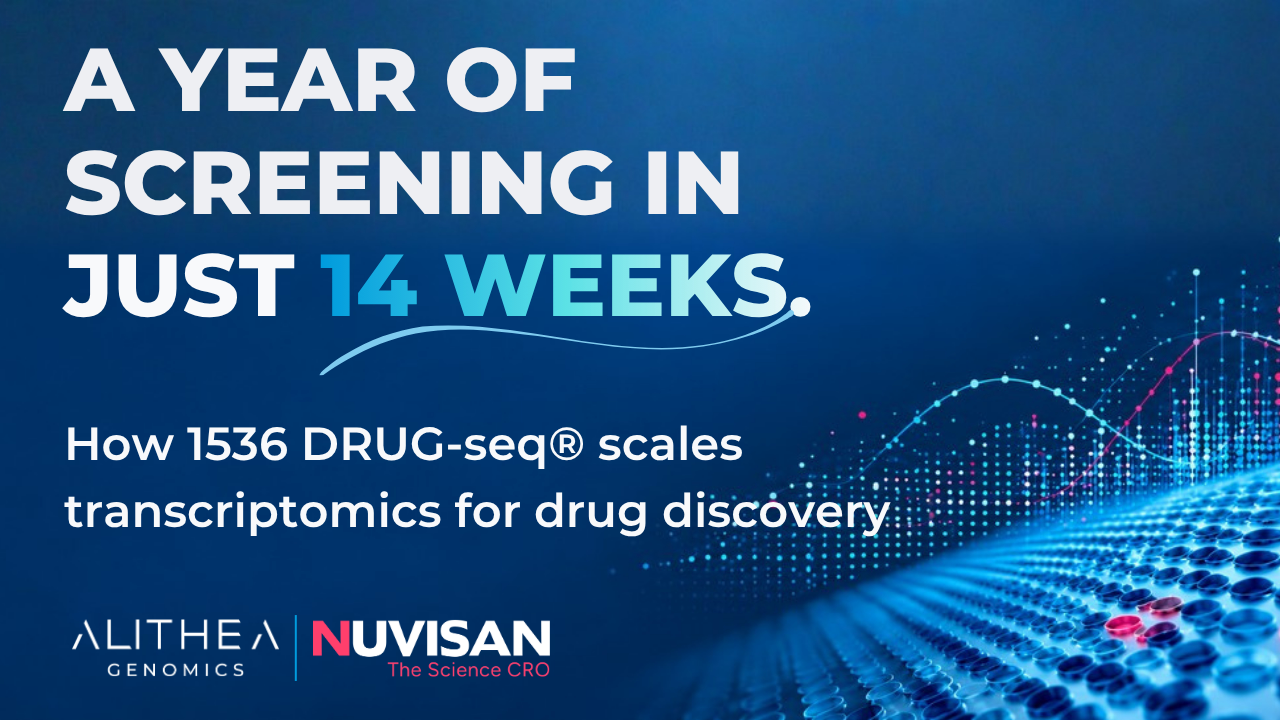
What would you screen if whole-transcriptome profiling ran in 1536-well plates? In this joint webinar, Zuzanna Makowska (Senior Scientist, Nuvisan) and Riccardo Dainese (CBO and co-founder, Alithea Genomics) show how MERCURIUS™ 1536 DRUG-seq brings transcriptomics to screening scale, end-to-end at Nuvisan.
Why 1536 wells?
AI-driven drug discovery needs large perturbation datasets that read biology directly. DRUG-seq reads more than 12,000 named genes per well, without RNA extraction, and pools a whole plate into one library. A 500,000-sample dataset fits on 350 plates in 1536-well format, against 1,400 plates in 384-well format.
What the data shows
Run side by side in three cell lines, the 1536-well format matches the 384-well format: the same demultiplexing rate, more than 12,000 genes per well at 1 million reads, compounds clustering by mode of action, and the same sensitivity for differential gene expression.
What you will learn
- How the automated 1536-well workflow runs, from cell seeding to one pooled library per plate
- How to plan a screen: cell model, plates, seeding density, controls, replicates and randomized layouts
- How deep to sequence, and what 4, 16 or 350 plates can deliver
- How DRUG-seq and Cell Painting together explain the mechanism behind a phenotype (adipocyte differentiation case study)
Speakers
Zuzanna Makowska – Senior Scientist, Nuvisan
Riccardo Dainese – CBO and co-founder, Alithea Genomics
Moderator: Sophia Shilimindri (Alithea Genomics)
Chapters
0:00 Welcome and agenda
1:36 Alithea Genomics and MERCURIUS™ DRUG-seq
2:36 Why AI-driven drug discovery needs perturbation data
3:15 Comparing readouts: L1000, single-cell RNA-seq, Cell Painting, DRUG-seq
5:16 The missing corner of the chemistry-to-biology map
7:38 How DRUG-seq works: extraction-free, barcoded, pooled
10:11 Why the cell model matters
12:09 What makes DRUG-seq work at scale
13:15 End-to-end 1536 DRUG-seq with Nuvisan
14:47 Nuvisan: drug discovery and sequencing in Berlin
16:46 DRUG-seq at Nuvisan since 2024
17:49 The automated 1536-well workflow
21:10 384 vs 1536 wells: technical performance
22:55 Clustering compounds by mode of action
24:31 Dose response and differential gene expression
26:31 Planning an experiment: cell model, plates, seeding density
29:30 Controls, replicates and randomized layouts
32:41 Perturbations: time point, dose, CRISPR and RNAi
34:34 Sequencing depth and data analysis
36:08 What can you do with 1536 wells?
38:25 Cell models, compound libraries and combined readouts
41:24 Case study: Cell Painting + DRUG-seq in adipocyte differentiation
44:32 Q&A: how many cells per well?
45:45 Q&A: runtime compared with 384-well plates
46:37 Q&A: several plates on one flow cell
47:08 Q&A: primary cells, iPSC-derived cells and 3D models
48:10 Q&A: how many replicates?
49:21 Q&A: sending treated cells to Nuvisan
50:04 Q&A: long-read sequencing and isoforms