
MERCURIUS™
Full-Length BRB-seq Kit
for cost-effective bulk
RNA-seq
Stranded full-length library preparation kits featuring early multiplexing for purified RNA - compatible with all eukaryotic cells.
Discover Sample Datasets
Human
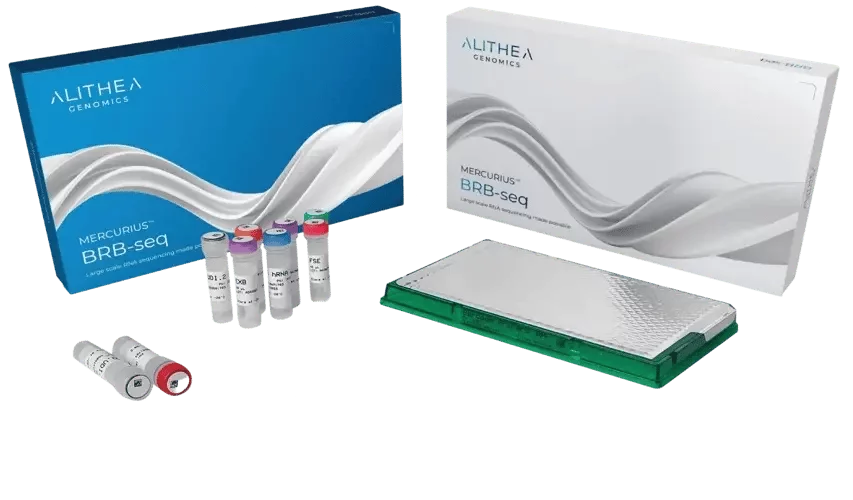
Multiplexed
full-length mRNA-seq
Full-length
transcript coverage
One-day library prep workflow
For a variety of sample types
Product Overview
Built for teams aiming to detect full-length protein coding transcripts, isoforms, and splice variants in purified RNA from larger cohorts, more conditions, or more timepoints than possible with standard total RNA-seq methods.
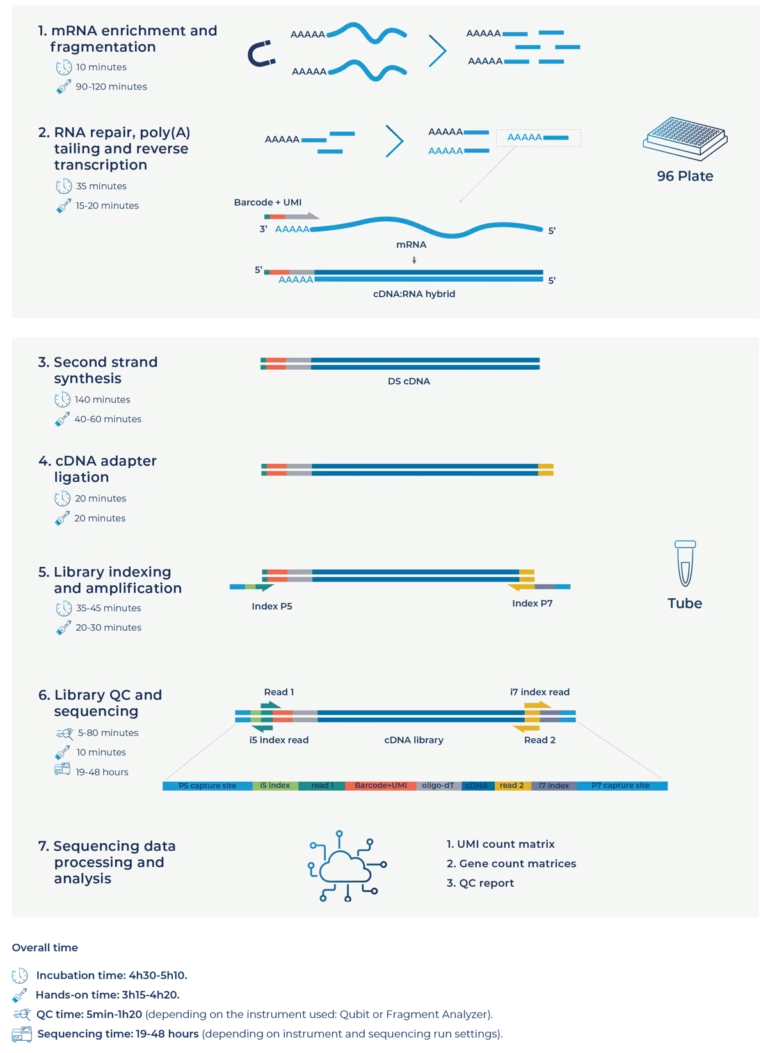
MERCURIUS™ Full-Length BRB-seq combines early sample barcoding and multiplexing for full-length coverage of coding transcripts for up to 96 purified RNA samples in a single tube. It enables high-throughput mRNA-seq on Illumina® and AVITI™ platforms without compromising depth, data quality, or sensitivity compared to sample-by-sample methods.
12M reads/sample
12M reads/sample
Applications
- Full-length bulk RNA-seq for differential expression, alternative splicing and isoform detection in tissues, primary cells and cell lines.
- Studies needing higher information content than 3′ RNA-seq (UTR usage, promoter switching, isoform detection, fusion transcripts).
- Biomarker and target discovery at transcript/isoform level in large cohorts while keeping per-sample cost manageable.
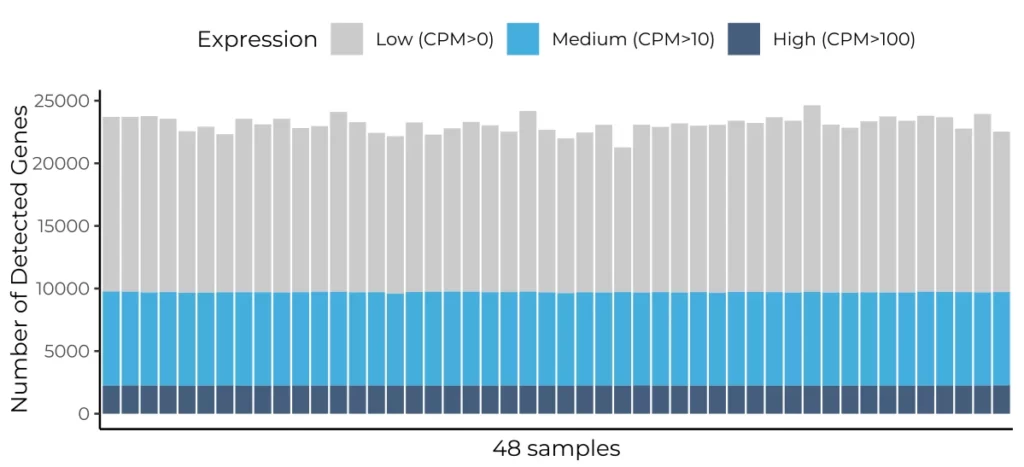
MERCURIUS™ Full-Length BRB-seq Delivers Consistent Gene Detection Across Samples
Number of genes detected per sample across a 48-sample MERCURIUS™ Full-Length BRB-seq run, stratified by expression level. All 48 samples show highly uniform gene detection, with approximately 22,000–24,000 genes detected at 12M reads/sample. The consistency across samples demonstrates the reproducibility of MERCURIUS™ Full-Length BRB-seq for high-throughput transcriptomic profiling.
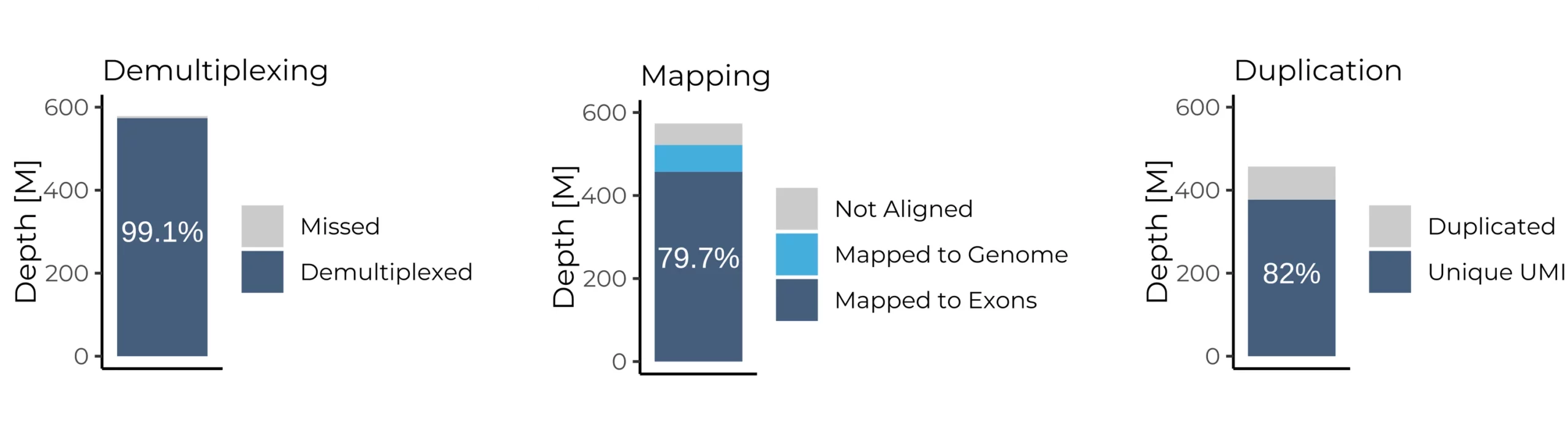
2. MERCURIUS™ Full-Length BRB-seq Achieves High Demultiplexing, Exonic Mapping, and UMI Complexity
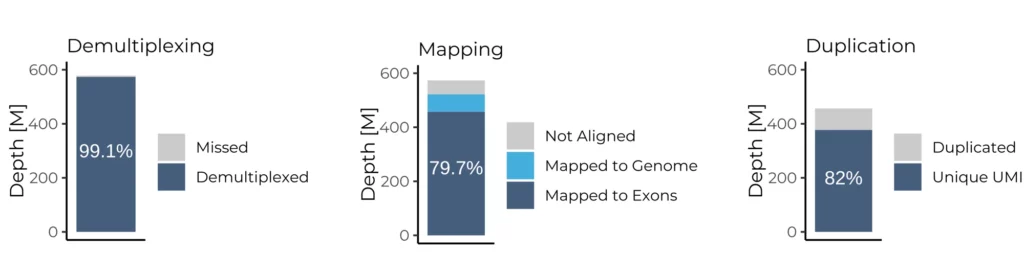
Sequencing quality metrics across three data preprocessing stages for a MERCURIUS™ Full-Length BRB-seq library. (Left) 99.1% of reads were successfully demultiplexed, confirming highly accurate barcode assignment with minimal read loss. (Centre) 79.7% of mapped reads aligned to exonic regions, indicating efficient transcript capture. (Right) 82% of reads represent unique UMI-tagged molecules, indicating low duplication rates and high library complexity. Together, these metrics demonstrate the technical robustness and sequencing efficiency of MERCURIUS™ Full-Length BRB-seq.
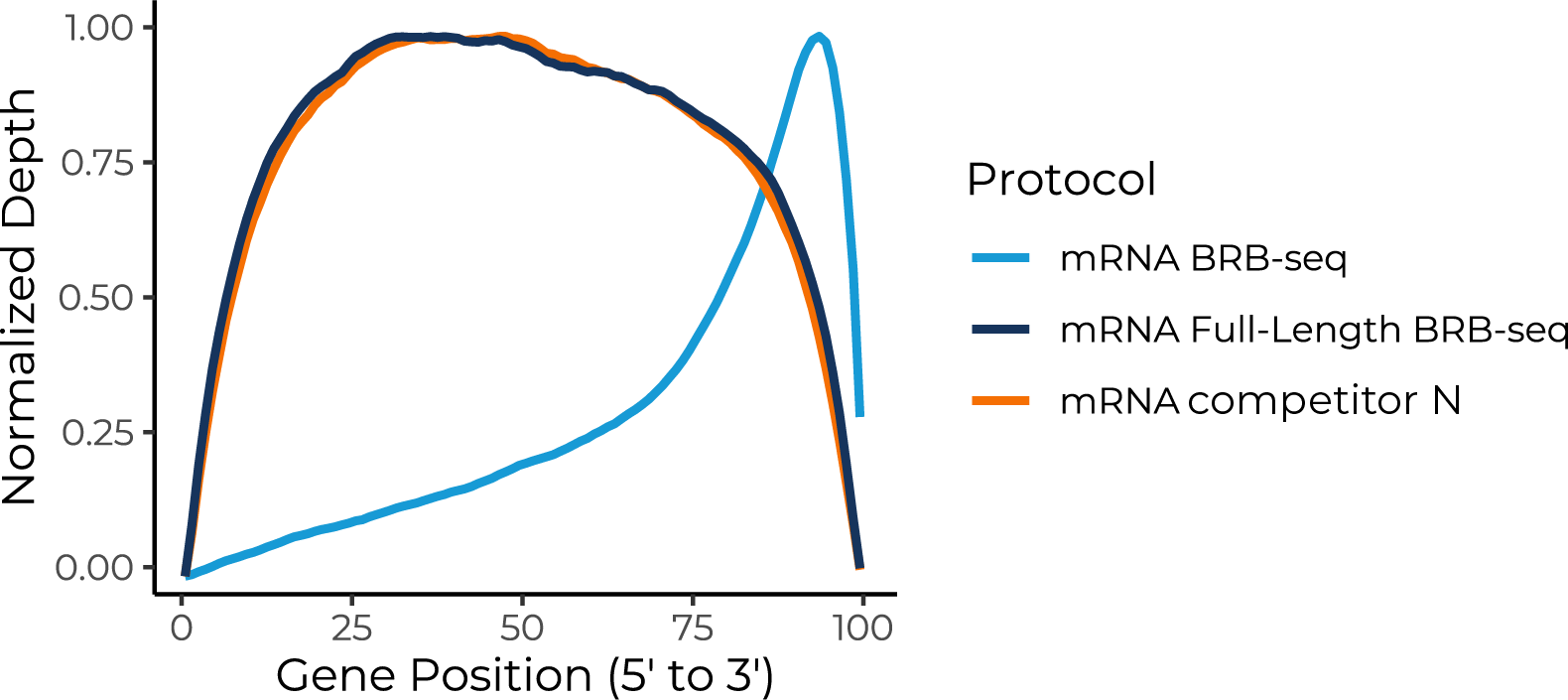
3. MERCURIUS™ Full-Length BRB-seq Achieves Uniform Gene Body Coverage Comparable to Competitor
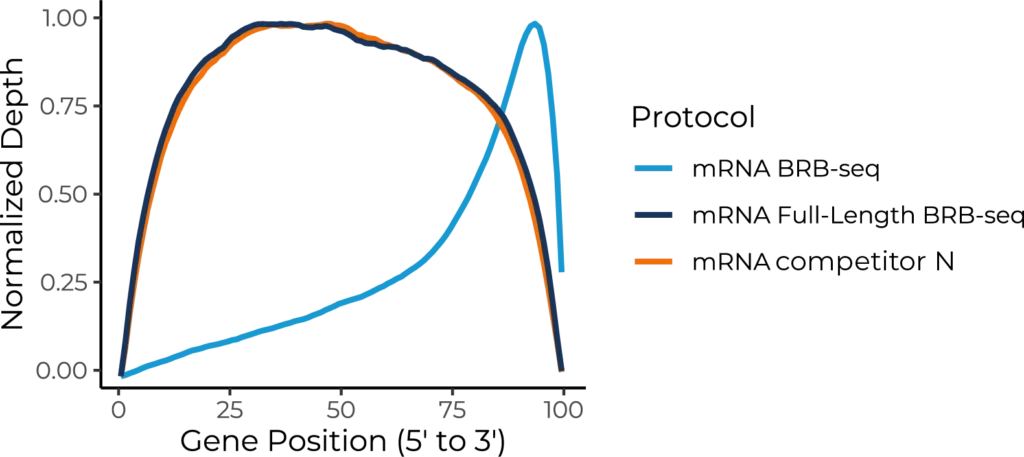
Normalized read depth across gene bodies (5′ to 3′). MERCURIUS™ Full-Length BRB-seq produces a uniform coverage profile across the entire gene body length, closely matching Competitor N. In contrast, standard BRB-seq shows characteristic 3′-end enrichment, owing to its 3′-capture design. This illustrates the advantage of MERCURIUS™ Full-Length BRB-seq for applications requiring uniform transcript coverage, such as isoform detection, splice variant analysis, and allele-specific expression.
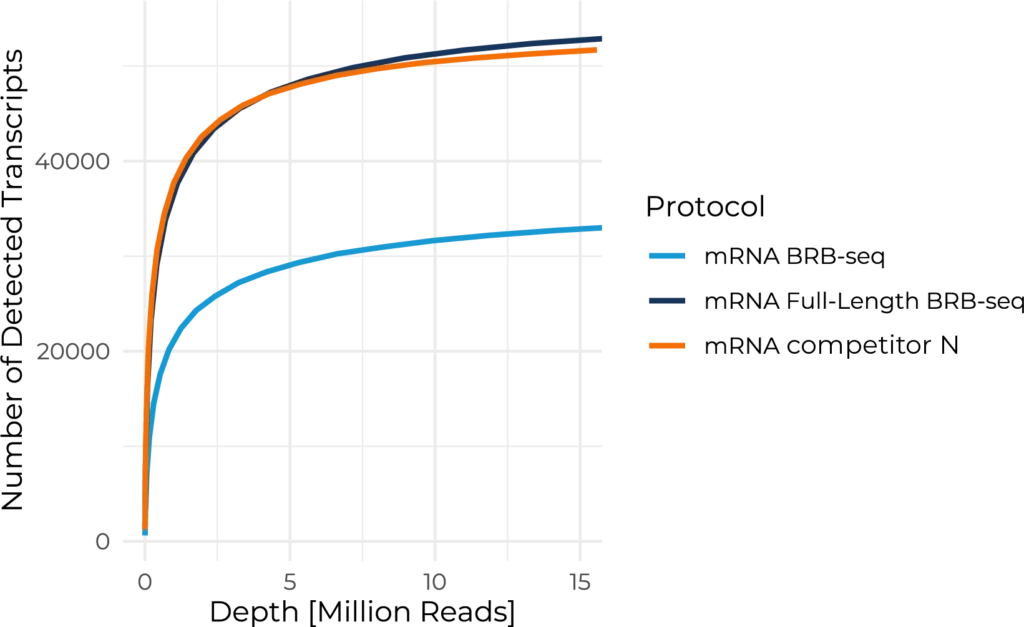
MERCURIUS™ Full-Length BRB-seq Matches Competitor Transcript Detection at All Sequencing Depths
Number of detected transcripts as a function of downsampled sequencing depth for different technologies. MERCURIUS™ Full-Length BRB-seq closely tracks Competitor N across all read depths. Standard BRB-seq detects fewer transcripts, reflecting its 3′-capture design, which limits isoform resolution. These results demonstrate that MERCURIUS™ Full Length BRB-seq delivers competitor-equivalent transcript detection at higher throughput and lower cost.
Full-Length (Plant) BRB-Seq Shows High Demultiplexing Rate And High Mapping Rate To Exons
Full-Length (Plant) BRB-seq performance shows 99% demultiplexing rate from raw data, 78% mapping rate, and 18% duplication rate of the 48 pooled samples and sequenced at 12 million reads per sample.
Full-Length (Plant) BRB-Seq Has Reads Distributed Across Entire Transcript Lengths
The gene body coverage shows a consistent and uniform reads distribution across the entire gene body for the Full-Length (Plant) BRB-seq protocol, comparable to the NEB protocol, while the BRB-seq protocol shows a significant 3′ bias due to its poly-A selection methodology.
Sample Datasets
Human
96
10'000 reads
To have access to the deep-sequenced dataset, contact us.
238 MB
Product documentation
Publications
- 3' BRB-seq, BRB-seq
Larissa Carvalho Costa, Christopher Gottschalk, Davis M. Upchurch, Oscar P. Hurtado-Gonzales, Ben N. Mansfeld, Alan Yocca, Lauren Whitt, Cheryl Vann, Gennaro Fazio
- 3' BRB-seq, BRB-seq
Stéphanie Boder‐Pasche, Mustafa Demir, Sarah Heub, Manon Garzuel, Réal Ischer, Daniel Migliozzi, Siegfried Graf, Noa Schmid, H. Baris Atakan, Daria Gudkova, Daniel Alpern, Riccardo Dainese, Bart Deplancke, Gilles Weder
- 3' BRB-seq, BRB-seq
Maxine Leonardi, Yves Paychère, Felix Naef.
Application
Equipment compatibility
Species compatibility
Available formats
Shipping conditions
Storage conditions
How many pools can I prepare with one kit?
Each Full-Length BRB-seq kit contains reagents (including four pairs of Unique Dual Indexing adapters) sufficient for the complete library preparation process for four different BRB-seq pools.
For instance, the 96-samples kit can be used to prepare up-to 96 samples distributed across up-to four different libraries.
What are the requirements for the RNA samples?
The recommended range of RNA amount for each sample is of 10-1000 ng, normally the more RNA, the better.
The minimum recommended RIN number is 6 and the A260/230 ratio (Nanodrop) should be in the 1.5-2.2 range.
How does the bioinformatic analysis differ as compared to standard RNA-seq?
The only difference between Full-Length BRB-seq and standard RNA-seq data analysis is the demultiplexing step, which is used to assign sequencing reads to their sample of origin based on the BRB-seq barcode sequence.
For a thorough description of Full-Length BRB-seq data processing, please look at the BRB-seq kit user guide.
How do I identify which barcode set I should use to demultiplex my data?
The barcode set for your kit is conveniently located on the kit label. Please refer to the label for accurate identification.
For optimal compatibility, ensure that you use the appropriate plate format (e.g., for kits designed for 96 reactions, the 96 well-plate format should be used). This ensures accurate and efficient processing of your samples. If you have any further questions or concerns, please contact our support team for assistance by email or using our live chat tool.
What is the recommended sequencing depth for each RNA sample?
Full-Length BRB-seq provides comprehensive coverage of the full-length mRNA transcripts.
We, therefore, normally recommend sequencing 12-20 million reads for each sample, which enables the reliable and unbiased detection of over 20,000 genes.
Ask your question:
Kit name
Catalog number
pairs
MERCURIUS™ Full-Length BRB-seq library prep kit (96 preps)
all eukaryotic species
MERCURIUS™ Full-Length BRB-seq library prep kit (4x96 preps)
all eukaryotic species
Accessories
Product
Catalog Number
MERCURIUS™ X-Leap-compatible MF.UDI Expansion module
MERCURIUS™ X-Leap-compatible MF.UDI Expansion module
MERCURIUS™ Full-Length Post-Pooling Preparation Module (4 libraries)
Ordering tip
Each kit includes 4 UDI pairs. Add the expansion module if you need more unique indexes (total 16 UDI pairs available).
Relevant blogs
August 25, 2025
Determining the most suitable transcriptomic technology to drive your large-scale compound screen, clinical study, or to assess a panel of genetic perturbations can be a…
August 25, 2025
‘High-throughput’ in sequencing refers to the amount of DNA molecules read at the same time. Technologies are now capable of sequencing many fragments of DNA…
May 9, 2025
With a growing number of published 3’ mRNA-seq methods now available, researchers have more choices than ever for high-throughput and cost-effective transcriptomic screening. While broadly…