
Massively multiplexed low-input RNA-seq, compatible with low-input RNA samples from 1ng.
The MERCURIUS™ High sensitivity BRB-seq service offers a convenient and scalable solution for transcriptomics projects with a limited input amount of RNA (starting from 1 ng per sample).
As part of the service, users simply deliver their 96- or 384-well plates containing frozen cells to us in Switzerland or the United States.
Upon receipt of the plates, our team prepares the libraries, then sequences to your desired read depth per sample, and then performs data pre-processing.
We return results, including raw FASTQ files, sequencing and alignment reports, and gene count matrices suitable for downstream differential expression analyses, once the data meet our rigorous quality control criteria.
During the process, we always keep clients informed at defined checkpoints so we can decide together how best to proceed to the next steps.
(Nanodrop and Fragment analyzer)
1 week
2 days
(Qubit, Fragment analyzer, shallow sequencing)
1 week
1 week
1 week
Raw FASTQ files, sample report file, QC files, and gene count tables
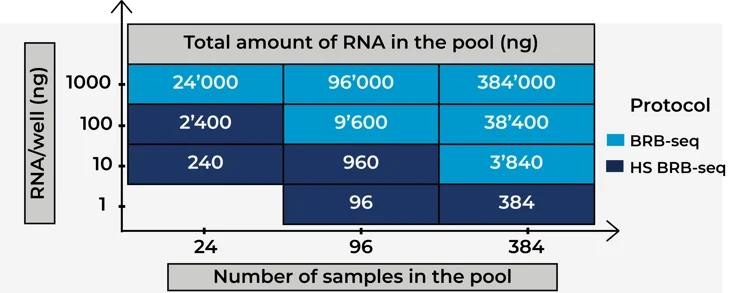
Total RNA input requirements for MERCURIUS™ BRB-seq and High Sensitivity BRB-seq (HS BRB-seq) across pool sizes of 24, 96, and 384 samples, and per-well RNA inputs of 1–1,000 ng. Standard BRB-seq supports per-well inputs from 10–1,000 ng, while HS BRB-seq extends compatibility down to 1 ng per well, enabling profiling of low-input samples such as rare cell populations or limited clinical material. Together, the two protocols cover total pool inputs ranging from 96 ng to 384,000 ng, providing a flexible and scalable solution for experiments of any size.
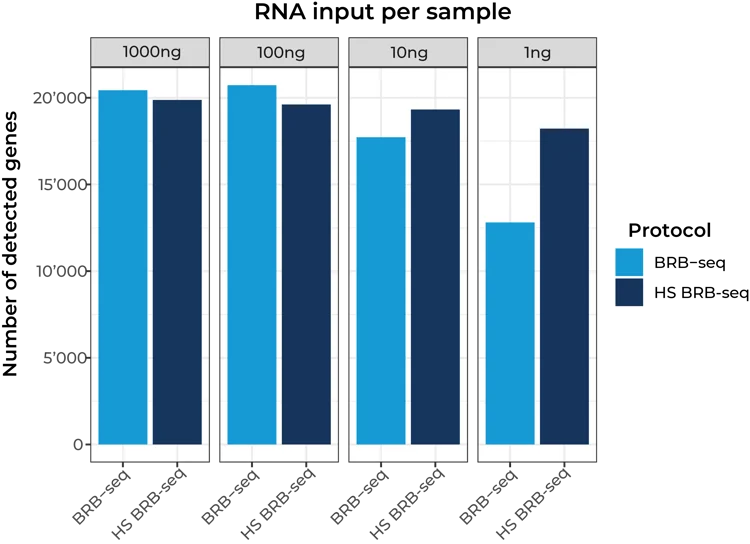
Number of detected genes between MERCURIUS™ BRB-seq and MERCURIUS™ High Sensitivity BRB-seq at different RNA inputs per sample. 96 samples were pooled together and sequenced at 2M reads/sample, and all replicates were prepared from the same RNA sample. These results demonstrate that MERCURIUS™ HS BRB-seq is the protocol of choice for low-input applications, preserving sensitivity where standard BRB-seq is compromised.
To have access to the deep-sequenced dataset (9.5 M reads per sample) contact us.
To have access to the deep-sequenced dataset (8.9 M reads per sample) contact us.
To have access to the deep-sequenced dataset (5.7 M reads per sample) contact us.
To have access to the deep-sequenced dataset (6.3 M reads per sample) contact us.
To have access to the deep-sequenced dataset (9 M reads per sample) contact us.
To have access to the deep-sequenced dataset (3 M reads per sample) contact us.
To have access to the deep-sequenced dataset (9 M reads per sample) contact us.
To have access to the deep-sequenced dataset (3 M reads per sample) contact us.
To have access to the deep-sequenced dataset (4 M reads per sample) contact us.
To have access to the deep-sequenced dataset (5.3 M reads per sample) contact us.
To have access to the deep-sequenced dataset (4.7 M reads per sample) contact us.
Larissa Carvalho Costa, Christopher Gottschalk, Davis M. Upchurch, Oscar P. Hurtado-Gonzales, Ben N. Mansfeld, Alan Yocca, Lauren Whitt, Cheryl Vann, Gennaro Fazio
Stéphanie Boder‐Pasche, Mustafa Demir, Sarah Heub, Manon Garzuel, Réal Ischer, Daniel Migliozzi, Siegfried Graf, Noa Schmid, H. Baris Atakan, Daria Gudkova, Daniel Alpern, Riccardo Dainese, Bart Deplancke, Gilles Weder
Maxine Leonardi, Yves Paychère, Felix Naef.
MERCURIUS™ High-Sensitivity BRB-seq supports RNA inputs as low as 1 ng per sample.
For routine service projects, we typically request at least 2 ng/µL of purified total RNA in a minimum volume of 15 µL (30 ng total). This provides sufficient material for quality control and library preparation.
If your samples contain less RNA, please contact our team to discuss feasibility and sample submission requirements.
In addition to total RNA amount, it is important that the samples contain RNA of high integrity (RIN > =6) and are devoid of contaminants (Nanodrop A260/A230 between 1.8 and 2.2).
BRB-seq is 3’-end RNA sequencing method and, as such, requires significantly less sequencing as compared to standard full-length RNA-seq in order to reach accurate gene quantification. We therefore normally recommend sequencing 4 to 5 million reads for each sample, which enables the reliable and unbiased detection of over 15’000 genes.
As part of our standard service pipeline, we align the generated data to the genome of choice, provide a detailed report on the alignment and gene counting statistics and, finally, provide ready-to-use gene count matrices for downstream analysis.
You can either book a call with our experts to discuss your project or submit your experimental details via our contact form so we can review your design and requirements.
Based on the goals, sample types, and scale of your study, we may recommend starting with a pilot project to optimise conditions and de-risk a larger screen.
If you’re interested in implementing the technology in your own lab instead, you can explore our MERCURIUS™ High Sensitivity BRB-seq on the dedicated kits page.
Determining the most suitable transcriptomic technology to drive your large-scale compound screen, clinical study, or to assess a panel of genetic perturbations can be a…
‘High-throughput’ in sequencing refers to the amount of DNA molecules read at the same time. Technologies are now capable of sequencing many fragments of DNA…
With a growing number of published 3’ mRNA-seq methods now available, researchers have more choices than ever for high-throughput and cost-effective transcriptomic screening. While broadly…