
Streamlined total RNA-seq service for purified plant RNA, combining plant-focused rRNA depletion with early multiplexing to make whole-transcriptome profiling more accessible across plant research, crop science, and agrochemical R&D.
Our MERCURIUS™ Total Plant BRB-seq service is a convenient and scalable solution for projects of any size, enabling transcriptome-wide detection of full-length coding and non-coding transcripts.
As part of the Total Plant BRB-seq service, users simply deliver their 96-well plates containing frozen purified RNA to us in Switzerland or the United States.
Upon receipt of the plates, our team prepares the libraries, sequences to your desired read depth per sample, and performs data preprocessing.
We return results, including raw fastq files, sequencing and alignment reports, and gene count matrices suitable for downstream differential expression analyses, once the data meet our rigorous quality control criteria.
During the process, we always keep clients informed at defined checkpoints so we can decide together how best to proceed to the next steps.
(Nanodrop and Fragment analyzer)
1 week
2 days
(Qubit, Fragment analyzer, shallow sequencing)
1 week
1 week
1 week
Raw FASTQ files, sample report file, QC files, and gene count tables
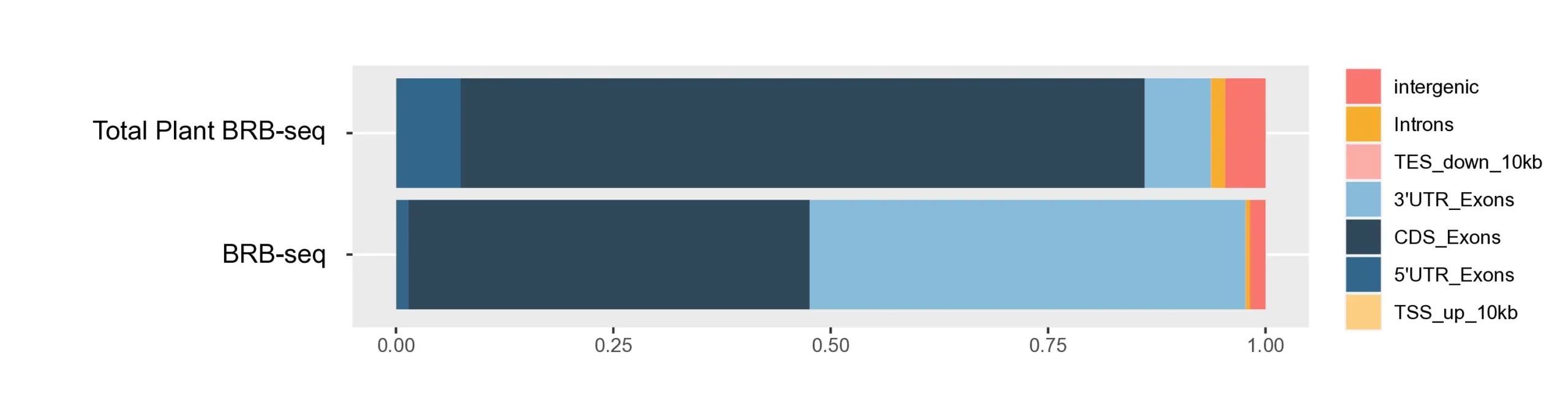
Stacked bar plots showing the distribution of mapped reads for Total Plant BRB-seq and BRB-seq in A. thaliana. A higher proportion of Total Plant BRB-seq reads map to coding (CDS) as expected for full-length methods.
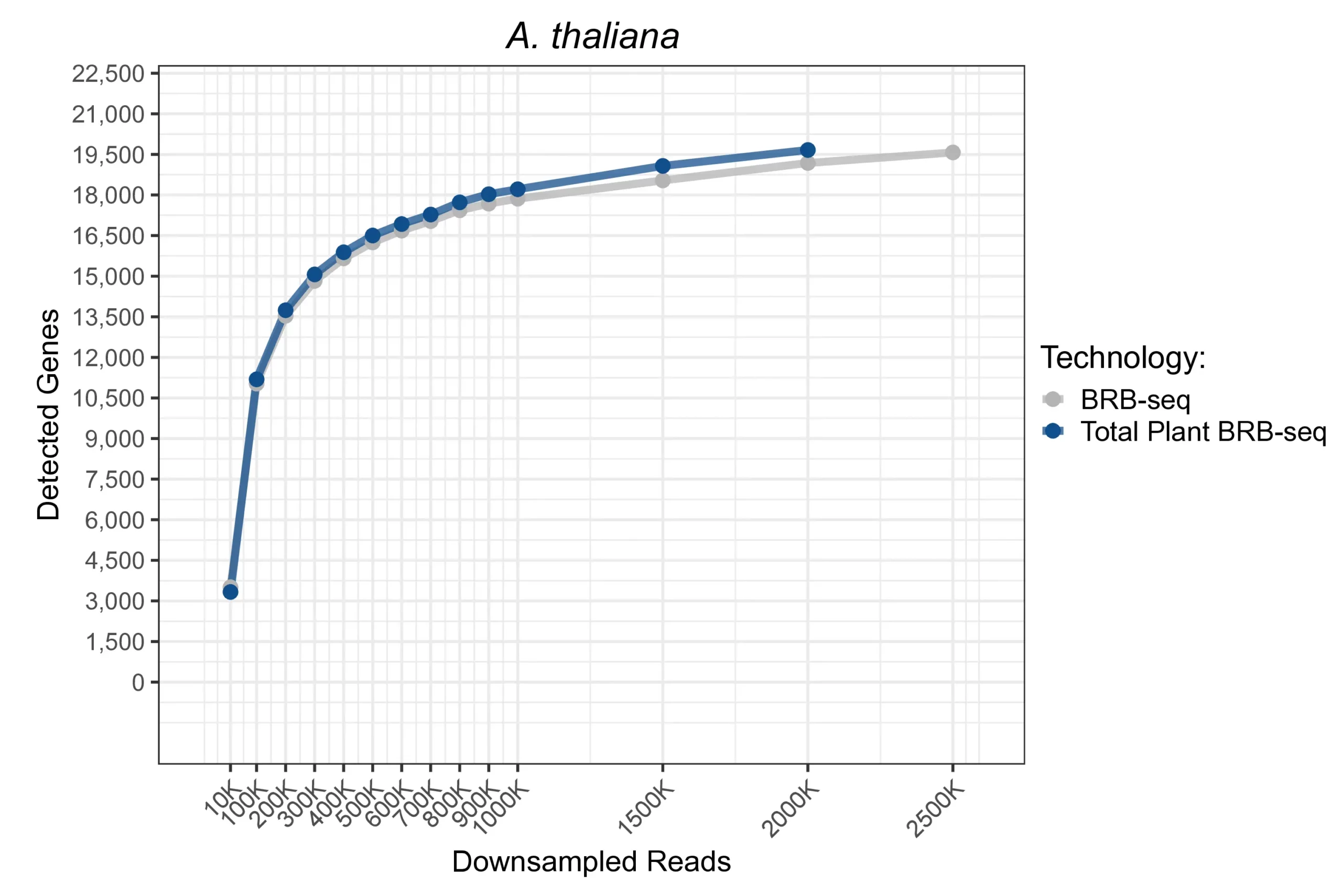
Saturation curves comparing Total Plant BRB-seq and BRB-seq gene detection across a range of downsampled read depths in A. thaliana. Total Plant BRB-seq detects a similar number of genes to BRB-seq across all downsampled sequencing depths, with both methods detecting around 18,000 genes at 1M reads per sample. The full-length information is especially beneficial for less well-annotated genomes, where 3’ UTR may not be complete.
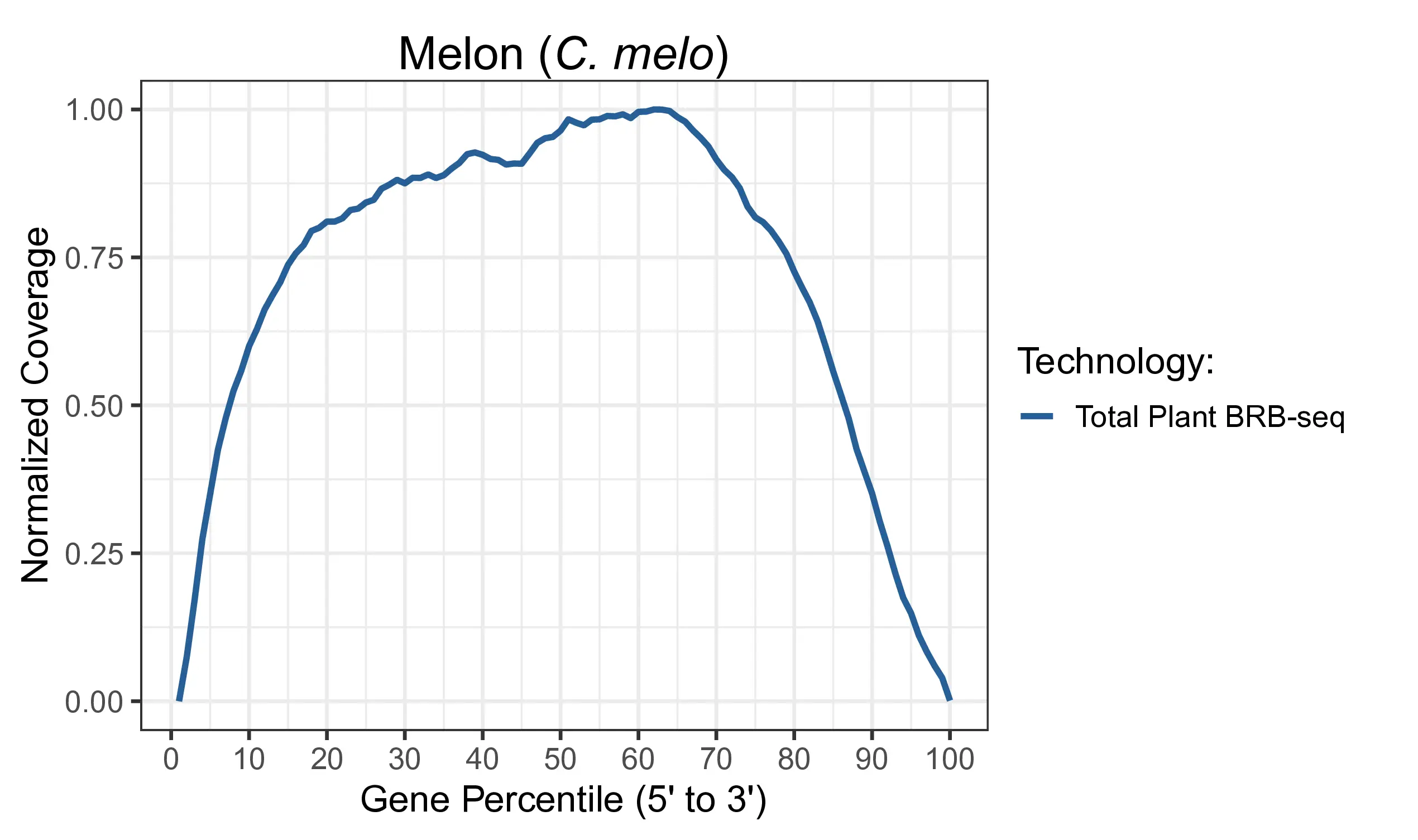
Normalized 5’ to 3’ read coverage across the transcript body for Total Plant BRB-seq in C. melo. Reads are distributed broadly across the full transcript length, confirming that Total Plant BRB-seq captures full-length transcript information rather than the 3′-bias associated with standard poly-A enrichment methods like BRB-seq.
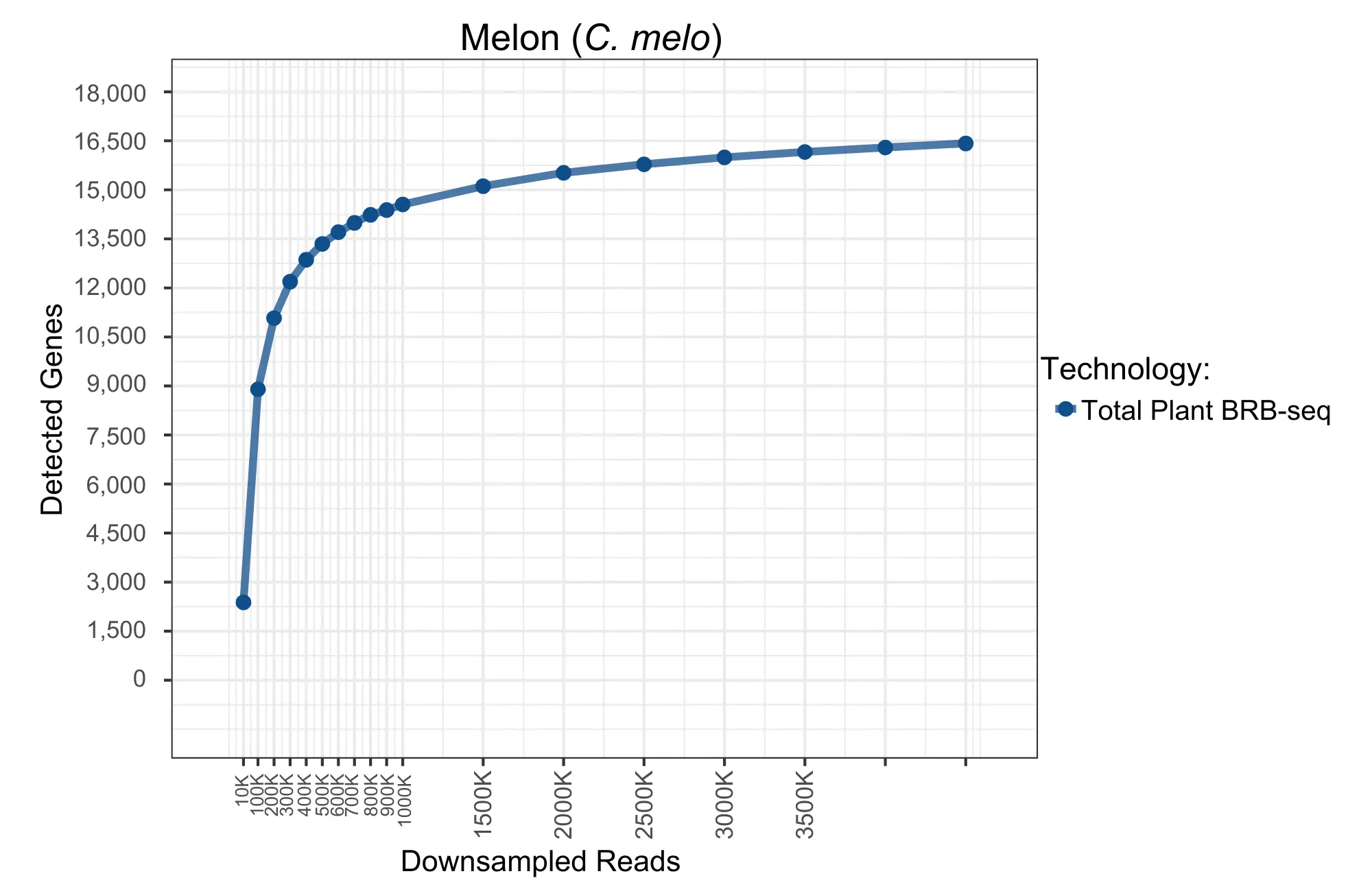
Gene detection saturation curve for Total Plant BRB-seq in C. melo, with detected genes as a function of downsampled read depth. Gene detection increases rapidly below 500K reads per sample, demonstrating broad coverage of the C. melo transcriptome.
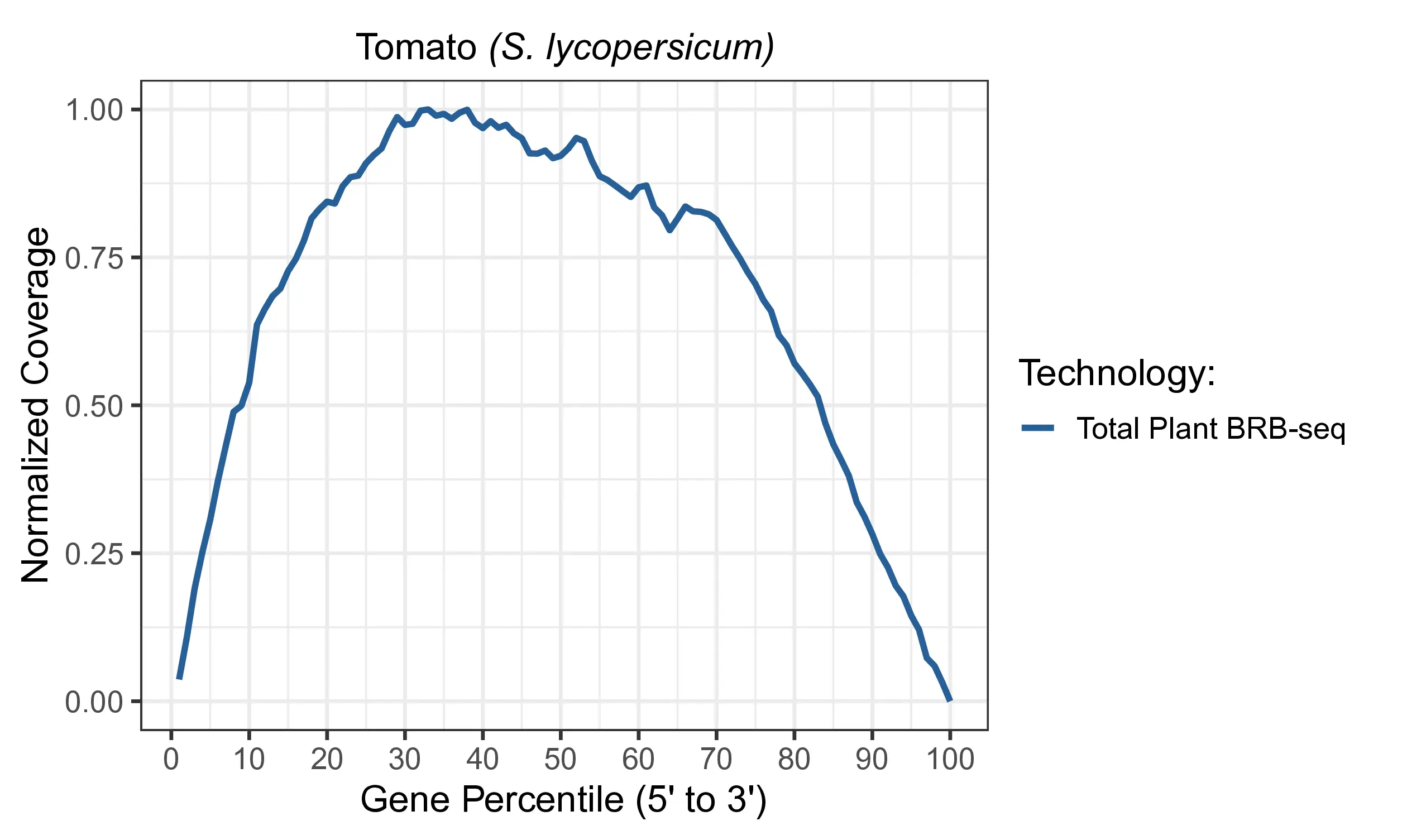
Normalized 5’ to 3’ read coverage across the transcript body for Total Plant BRB-seq in S. lycopersicum. Reads are distributed broadly across the full transcript length, confirming that Total Plant BRB-seq captures full-length transcript information rather than the 3′-bias associated with standard poly-A enrichment methods like BRB-seq.
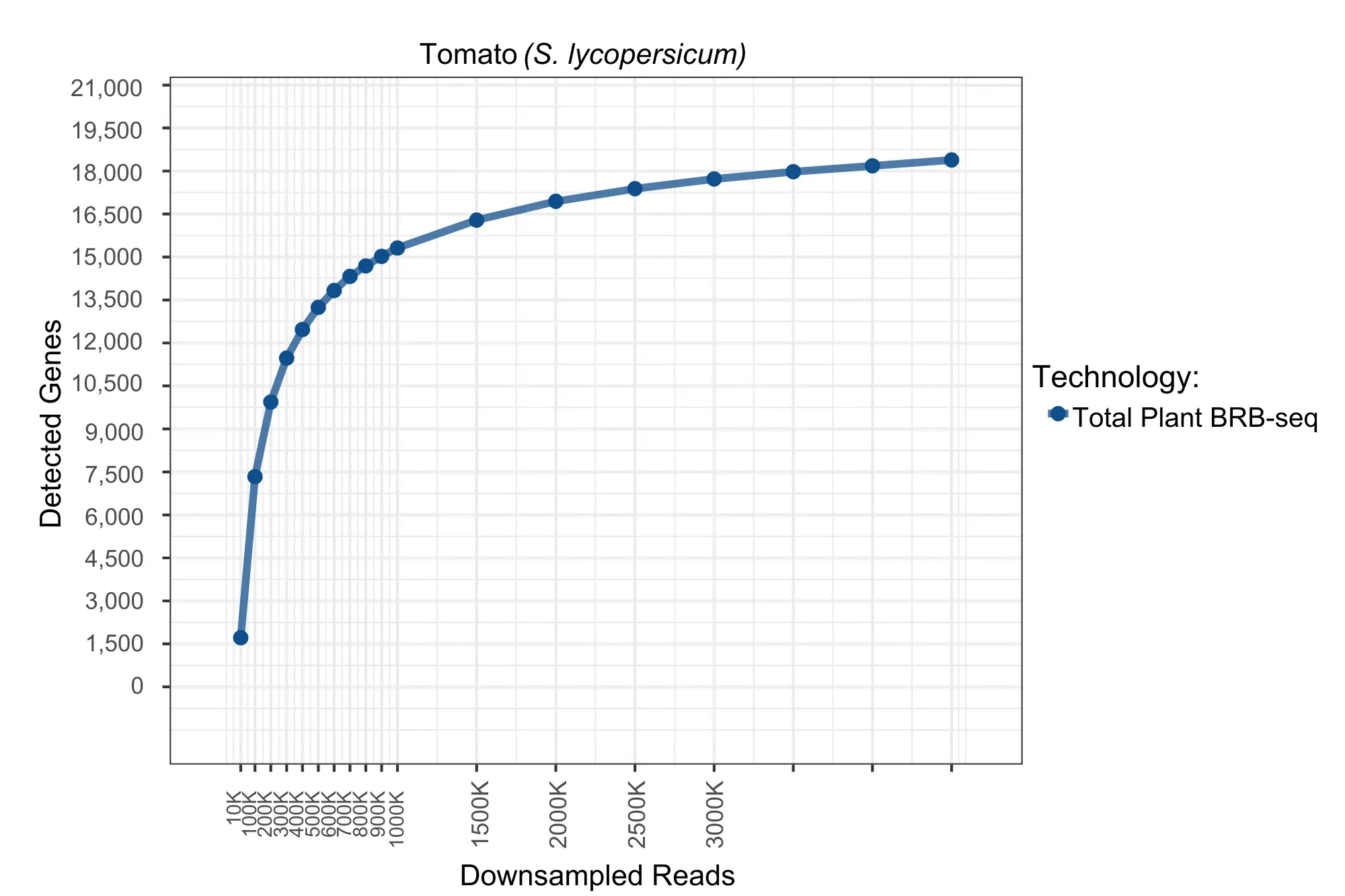
Gene detection saturation curve for Total Plant BRB-seq in S. lycopersicum, with detected genes shown as a function of downsampled read depth. Gene detection increases rapidly below 500K reads per sample and plateaus near saturation of approximately 16,500 genes at 4.5M reads.
Larissa Carvalho Costa, Christopher Gottschalk, Davis M. Upchurch, Oscar P. Hurtado-Gonzales, Ben N. Mansfeld, Alan Yocca, Lauren Whitt, Cheryl Vann, Gennaro Fazio
Stéphanie Boder‐Pasche, Mustafa Demir, Sarah Heub, Manon Garzuel, Réal Ischer, Daniel Migliozzi, Siegfried Graf, Noa Schmid, H. Baris Atakan, Daria Gudkova, Daniel Alpern, Riccardo Dainese, Bart Deplancke, Gilles Weder
Maxine Leonardi, Yves Paychère, Felix Naef.
The tested input range is 100 pg to 100 ng total RNA per well. For best results (library complexity + uniformity), aim for 10–100 ng per well, and pool at least 8 wells per library.
Because Total BRB-seq uses early multiplexing, it’s important that RNA quantity and quality are consistent across samples (e.g., RIN > 7, 260/230 > 1.5, and ~±10% input uniformity).
Total BRB-seq is designed for total RNA sequencing (not just mRNA), including coding and non-coding transcripts, and includes an rRNA depletion step prior to library prep.
We recommend 10-20 million reads for each sample, which enables the detection of 65,000 transcripts.
As part of our standard service pipeline, we align the generated data to the genome of choice, provide a detailed report on the alignment and gene counting statistics and, finally, provide ready-to-use gene count matrices for downstream analysis.
You can either book a call with our experts to discuss your project or submit your experimental details via our contact form so we can review your design and requirements.
If you’re interested in implementing the technology in your own lab instead, you can explore our MERCURIUS™ Total Plant BRB-seq kits on the dedicated kits page.
Determining the most suitable transcriptomic technology to drive your large-scale compound screen, clinical study, or to assess a panel of genetic perturbations can be a…
‘High-throughput’ in sequencing refers to the amount of DNA molecules read at the same time. Technologies are now capable of sequencing many fragments of DNA…
With a growing number of published 3’ mRNA-seq methods now available, researchers have more choices than ever for high-throughput and cost-effective transcriptomic screening. While broadly…