MERCURIUS™ Total BRB-seq versus NEBNext® and Watchmaker library preparation kits for total RNA: 20,000+ genes and 100,000+ transcripts at 5M reads/sample; 5,557 shared DE genes across methods; a moderate sensitivity trade-off for a multiplexed, lower-cost workflow.
Key takeaways
- Concordant expression: within-method replicate correlations of R ≈ 0.99, and cross-method correlations of R ≥ 0.98, across all three kits.
- Moderate sensitivity trade-off: 20,000+ genes and 100,000+ transcripts detected at 5M reads per sample for all kits. MERCURIUS™ Total BRB-seq detected about 5–6% fewer genes and about 12% fewer transcripts than the two non-multiplexed kits.
- Shared biology: 5,557 differentially expressed genes were identified by all three methods, with a fold-change correlation of R = 0.925 between MERCURIUS™ Total BRB-seq and Watchmaker, and epithelial-to-mesenchymal transition among the pathways enriched in the shared set.
- Fewer per-sample steps: after barcoded reverse transcription, the remaining steps run on a single pool, with an estimated 4.6 hours of protocol time for 96 samples versus about 6 hours for Watchmaker and 9.8 hours for NEBNext®.
- Lower cost per sample: MERCURIUS™ Total BRB-seq kits cost several-fold less per sample than NEBNext® and Watchmaker kits at October 2026 list prices for 96 samples.
Introduction
Total RNA-seq library preparation methods are widely used for transcriptome profiling because they capture both coding and non-coding transcripts across their full length, rather than only polyadenylated transcripts as in standard mRNA-seq or their 3’ ends as in 3’ mRNA-seq. However, most commercial total RNA-seq library preparation kits are labor-intensive and relatively slow, limiting throughput and driving up per-sample cost, particularly for large cohort or screening studies1. They often involve multiple single-tube reactions and cleanups per sample, with sample multiplexing occurring only at the final indexing step rather than early in the workflow.
In contrast, MERCURIUS™ Total BRB-seq (Bulk RNA Barcoding and sequencing) barcodes samples during reverse transcription and pools them immediately, so all remaining steps are performed once per pool rather than once per sample. This design is intended to reduce hands-on time and per-sample cost, but it raises the question of whether early multiplexing affects sensitivity or the biological conclusions drawn from the data.
This tech note benchmarks MERCURIUS™ Total BRB-seq against NEBNext® Ultra™ II Directional RNA Library Prep with rRNA Depletion (NEBNext®) and Watchmaker RNA Library Prep Kits with Polaris® Depletion (Watchmaker). It quantifies assay performance and assesses the trade-off between throughput, cost, and sensitivity to help researchers decide which approach may be most suitable.
Study Design
To generate a biologically relevant test case with a robust, reproducible transcriptional response, we induced epithelial-to-mesenchymal transition (EMT) in the Huh7 hepatocarcinoma cell line with TGF-β treatment for 48 hours, alongside untreated (NT) controls2,3. Alithea Genomics prepared libraries with MERCURIUS™ Total BRB-seq and NEBNext®, and a third-party prepared libraries with Watchmaker kits following the respective manufacturer protocols. We used the same treated and untreated purified RNA samples for each technology to ensure our benchmarking reflected the technical capability of the three library preparation methods, rather than biological variation between experiments. We excluded one Watchmaker replicate from downstream analysis after quality control (QC) flagged poor library quality; all other analyses reflect the remaining 7 Watchmaker samples. Experimental parameters are shown in Table 1.
| Parameter | Value |
| Cell model | Huh7 hepatocarcinoma cell line |
| Conditions | Untreated (NT) vs. 10 ng/mL TGF-β-treated (48 h) |
| Replicates | 4 technical replicates per condition (Watchmaker: one replicate excluded after QC, 7 samples analyzed) |
| RNA input | 100 ng purified total RNA |
| Kits compared (total RNA) | MERCURIUS™ Total BRB-seq (#10710), NEBNext® Ultra™ II Directional RNA Library Prep (E7760L) with rRNA Depletion Kit v2 (E7400X), Watchmaker RNA Library Prep Kit with Polaris® Depletion (7BK0002-096) |
| Sequencing | Element Biosciences AVITI, paired-end |
| Depth used for analysis | Downsampled to 10M reads/sample (5M max for saturation plots) |
Table 1. Experimental design summary.
Results
Fewer Processing Steps and Lower Cost Per Sample
Slow or expensive workflows may become unsuitable as sample numbers grow. Therefore, to assess the feasibility of large-scale studies with each technology, we estimated protocol duration and cost for users processing 96 total RNA samples simultaneously.
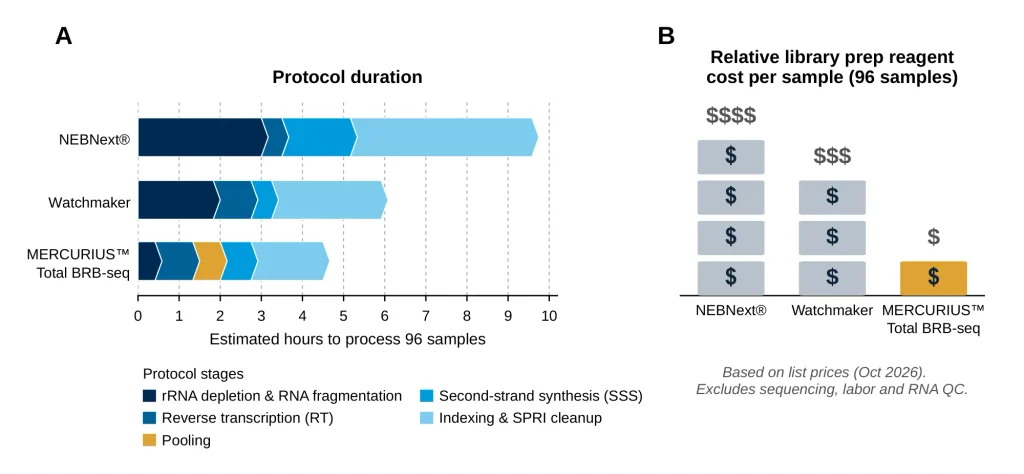
Figure 1. Comparison of estimated protocol duration and cost to process 96 samples from purified total RNA input to indexed library. (A) MERCURIUS™ Total BRB-seq is estimated to complete processing in approximately 4.6 hours per batch versus approximately 6 hours for Watchmaker and approximately 9.8 hours for NEBNext®. MERCURIUS™ Total BRB-seq is the only protocol that pools samples at the RT step early in the workflow for subsequent processing in a single tube. (B) MERCURIUS™ Total BRB-seq has the lowest reagent cost per sample of the three kits in this benchmarking comparison, based on October 2026 list prices. Sequencing, labor, and RNA QC are not included. Prices vary by region and supplier.
MERCURIUS™ Total BRB-seq had the shortest estimated protocol time, at 4.6 hours for 96 samples versus approximately 9.8 hours for NEBNext® and 6 hours for Watchmaker (Fig. 1A). A major contributor to the efficiency of MERCURIUS™ Total BRB-seq is the multiplexing of samples early in the workflow, with subsequent steps occurring on the pooled library instead of each sample individually (Fig. 1A). This reduces user effort and consumable cost for every sample, which adds up as batch sizes increase.
At current 2026 list prices for 96 samples, the library preparation reagents for MERCURIUS™ Total BRB-seq cost several-fold less per sample than those for NEBNext® and Watchmaker, including rRNA depletion, library preparation and indexing (Fig. 1B). Sequencing and labor costs depend on the facility and on the chosen read depth, so they are not included in this comparison.
Therefore, from a workflow and cost perspective, MERCURIUS™ Total BRB-seq is more suited to large-scale studies than standard total RNA-seq approaches.
Comparable rRNA Depletion, Mitochondrial RNA Levels, Read Mapping, and Distribution Across Gene Bodies
Before assessing gene and isoform detection sensitivity, we first compared numerous QC metrics for each technology. QC showed broadly similar outcomes across technologies. MERCURIUS™ Total BRB-seq and NEBNext® kits had comparable numbers of reads mapping to genes (65.9% vs. 66.1%), while Watchmaker had a lower proportion (61%) (Fig. 2A). For each technology, reads mapped along entire gene bodies with a moderate 3’ coverage bias in MERCURIUS™ Total BRB-seq consistent with its barcoding chemistry (Fig. 2B). A similar coverage bias was detected in NEBNext® and Watchmaker data but for the 5’ region (Fig. 2B).
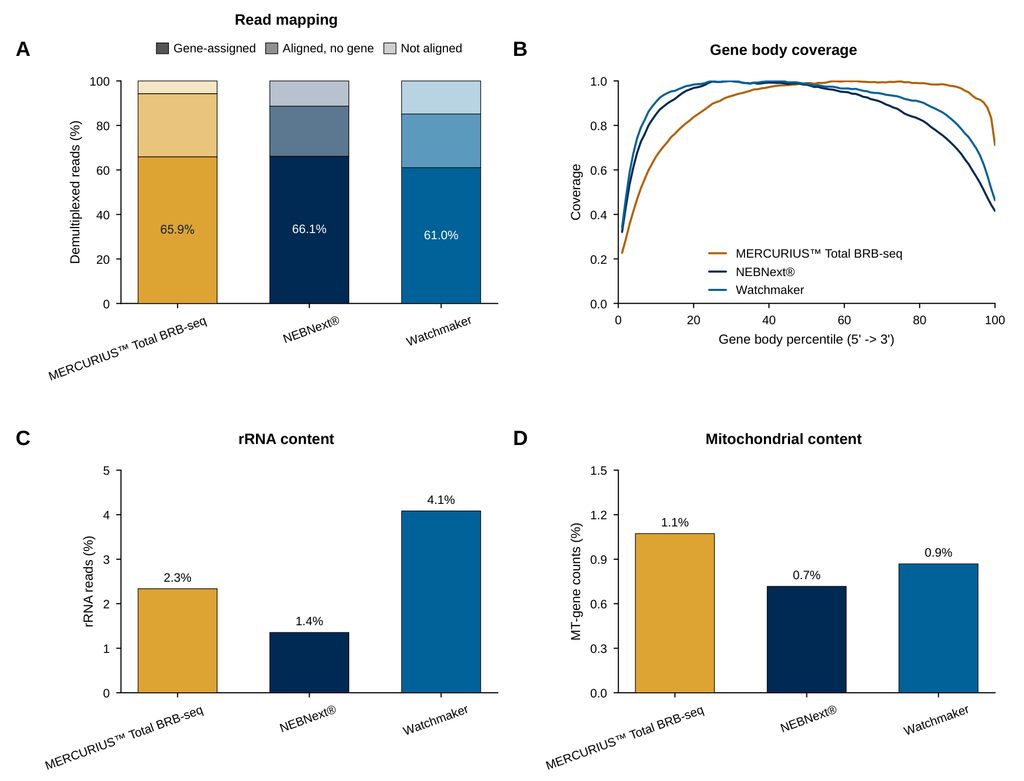
Figure 2. Read mapping quality, gene body distribution, rRNA carryover, and mitochondrial-mapped reads across total RNA library preparation methods. (A) Read mapping breakdown showing the percentage of demultiplexed reads that map to a gene, align without mapping to a gene, or remain unaligned, for each method. (B) Normalized gene-body coverage of mapped reads, 5′→3′. (C) Percentage of total reads mapping to ribosomal RNA (rRNA) for each method, reflecting the efficiency of rRNA depletion. (D) Percentage of reads mapping to mitochondrial (MT) genes. Bar charts show the mean of all analyzed replicates per technology.
Efficient depletion of abundant ribosomal RNA is necessary in total RNA-seq methods to ensure that sequencing budget is used to detect more biologically relevant transcripts. MERCURIUS™ Total BRB-seq and NEBNext® kits had low proportions of rRNA reads (2.3% vs. 1.4%), while Watchmaker had 4.1% of reads derived from rRNA (Fig. 2C). All technologies had similar levels of reads mapped to mitochondrial genes (Fig. 2D).
Only Moderate Reductions in Gene and Transcript Detection Sensitivity
After confirming the overall quality of each library, we assessed potential trade-offs between method scalability and gene and transcript detection sensitivity. At maximum sequencing depths, each technology detected over 30k genes in total, across low, medium, and high expression levels (Fig. 3A).
Next, to assess the effect of sequencing depth on gene detection sensitivity, we downsampled each library to 100k–5M reads per sample and computed gene and isoform detection. At low read depths of 500k reads per sample, MERCURIUS™ Total BRB-seq detected approximately 14k genes, with only a moderate reduction in sensitivity compared to the more labor-intensive, non-multiplexed NEBNext® and Watchmaker kits (Fig. 3B). At 5M downsampled reads/sample, MERCURIUS™ Total BRB-seq detected ~20,700 genes versus ~21,800 genes for NEBNext® and ~22,000 genes for Watchmaker kits, around 5–6% fewer genes (Fig. 3B). A similar sensitivity trend was also observed for transcript detection, where the two non-multiplexed kits detected around 116k transcripts versus approximately 102k transcripts for MERCURIUS™ Total BRB-seq, around 12% fewer (Fig. 3C).
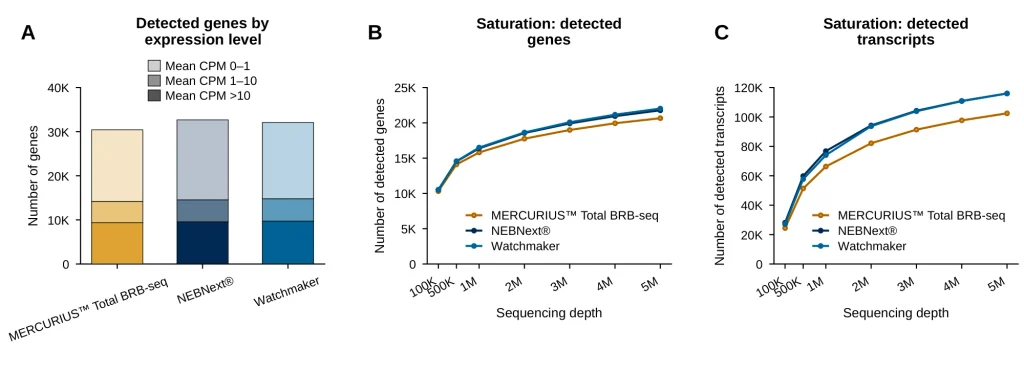
Figure 3. Gene and isoform detection sensitivity across sequencing depths. (A) Gene detection at maximum sequencing depths per technology. (B) Gene detection and (C) transcript detection after downsampling libraries to a common range of reads per sample (100k–5M). Plots show the mean of all analyzed replicates per technology.
Together, for large-scale studies, the increased sample multiplexing capacity and quicker workflow of MERCURIUS™ Total BRB-seq likely offset its moderate reduction in gene and transcript detection sensitivity versus standard total RNA-seq methods.
High Reproducibility and Cross-Method Concordance in Gene Expression Levels
To evaluate reproducibility and cross-method concordance, we compared gene expression levels across replicates and between the three library preparation methods. Within-method correlations were consistently around R = 0.99 for each technology, indicating that all three approaches generate highly reproducible expression measurements between replicates (Fig. 4A). Similarly, cross-method comparisons showed high gene expression level correlations of at least R = 0.98 across all technologies (Fig. 4B).
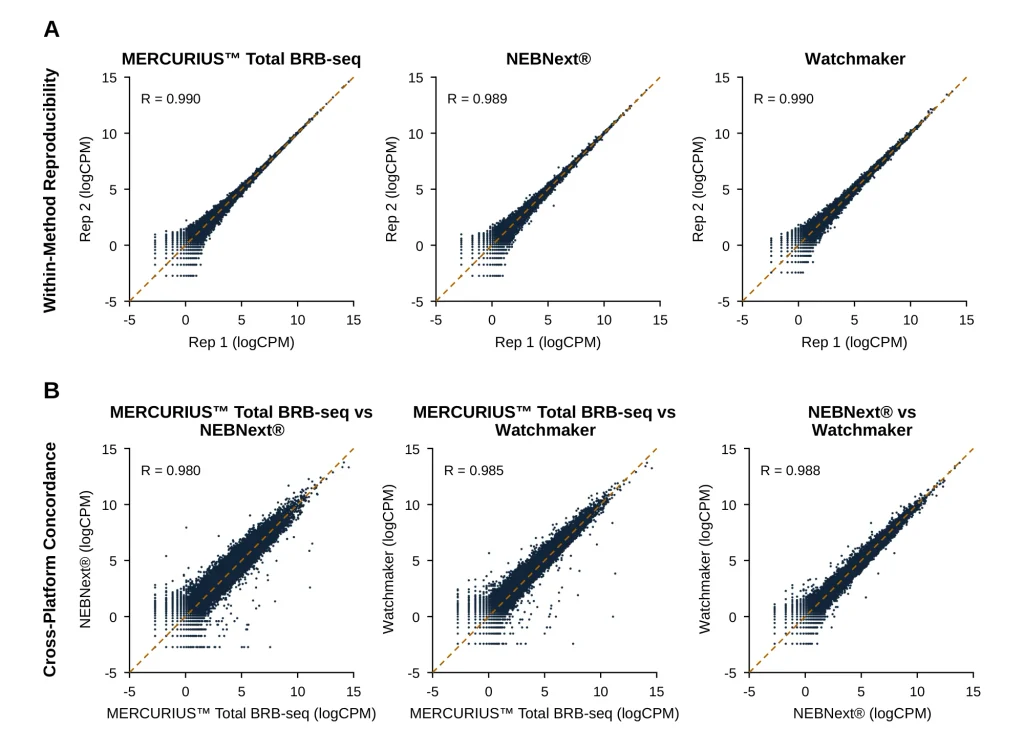
Figure 4. Within-method reproducibility and cross-platform concordance of gene expression quantification. Pairwise scatterplots of gene expression levels comparing (A) replicates within each library preparation method and (B) between methods. Pearson correlation coefficients (R) are shown in the top-left corner of each plot.
Together, these results demonstrate that MERCURIUS™ Total BRB-seq produces highly reproducible gene expression data that is closely concordant with two established total RNA-seq library preparation methods, supporting its use as a reliable alternative for large-scale total transcriptome profiling.
Concordant Differential Expression and Pathway Detection Across Technologies
Next, to evaluate concordance in differential expression (DE) gene detection across library preparation methods, we compared the number and overlap of DE genes identified independently by MERCURIUS™ Total BRB-seq, NEBNext®, and Watchmaker. All technologies detected similar numbers of DE genes, with the majority (5,557 DE genes) identified as significant by all three methods, representing substantial overlap in the underlying biologically relevant signal detected (Fig. 5A).
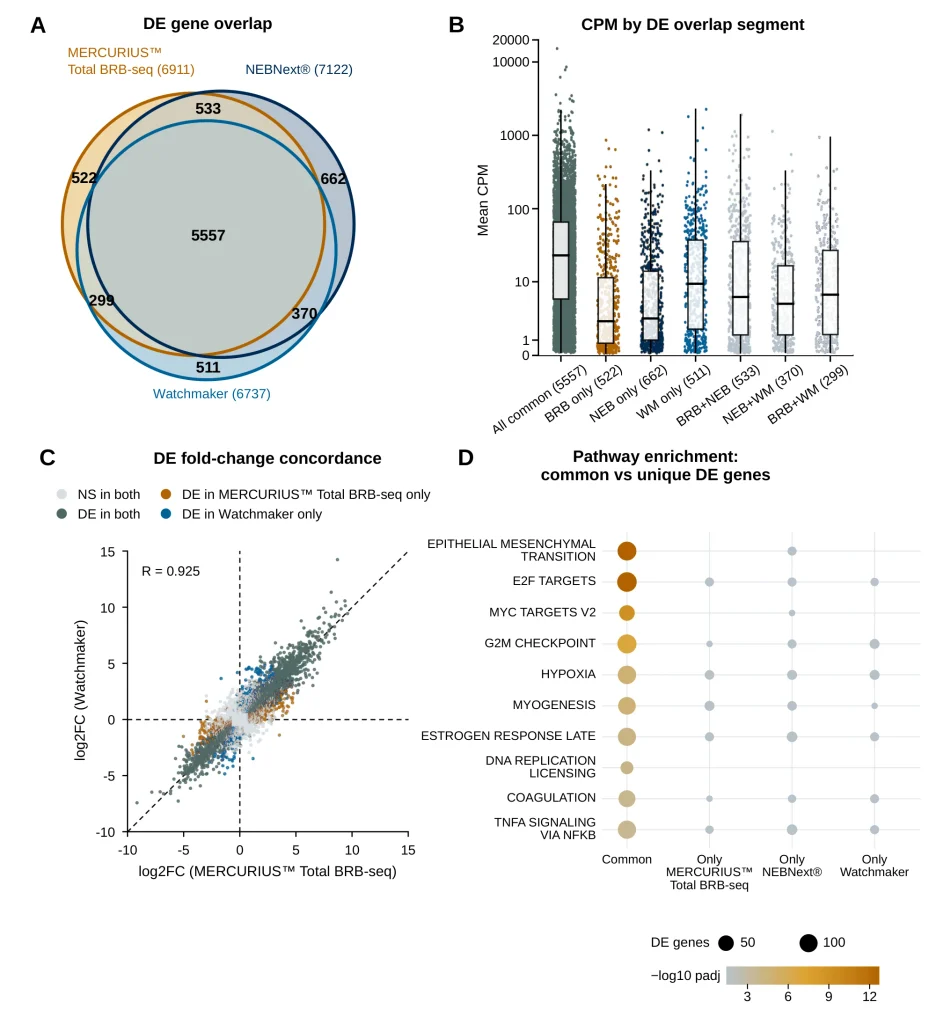
Figure 5. Overlap of differentially expressed genes with their expression characteristics and pathway involvement across total RNA library preparation protocols. (A) Venn diagram showing the overlap of differentially expressed (DE) genes identified independently by MERCURIUS™ Total BRB-seq (6,911 DE genes), NEBNext® (7,122 DE genes), and Watchmaker (6,737 DE genes). DE genes were called at Benjamini-Hochberg-adjusted p < 0.05 and |log2FC| > 0.585 (fold change > 1.5x), from a DESeq2 Wald test of TGF-β vs untreated, run separately per protocol. (B) Distribution of mean CPM expression values for genes in each overlap segment from the Venn diagram, shown as scatter points overlaid with box plots (median, interquartile range, and whiskers). (C) Scatterplot of log2 fold changes in MERCURIUS™ Total BRB-seq (x-axis) and Watchmaker Total RNA (y-axis), with genes colored by differential expression status. Comparison is shown only for Watchmaker, as it’s closest in protocol length and cost. (D) Dot plot showing pathway enrichment results for DE gene sets common to all three library preparation methods and for DE genes unique to each individual method.
Each method also identified a subset of DE genes not called by the other two, along with smaller sets shared between method pairs. To determine whether these method-specific and shared-pair DE genes reflect genuine biological differences or simply detection sensitivity near the significance threshold, we examined mean CPM (counts per million) expression levels across each overlap segment. Genes common to all three methods showed the highest and most variable expression levels (median mean CPM ~20–30), while genes unique to MERCURIUS™ Total BRB-seq and NEBNext® were predominantly low-expression transcripts (median mean CPM ~2–3), consistent with these genes falling near the limit of detection where small differences in sensitivity between platforms are most likely to influence significance calls, although this was higher for Watchmaker unique genes (median mean CPM ~10) (Fig. 5B). Genes shared between two of the three methods generally showed intermediate expression levels, further supporting that the observed discordance is driven primarily by expression-level-dependent detection sensitivity rather than systematic biological or technical discrepancies between the library preparation methods.
Fold changes of common DE genes were also highly correlated between MERCURIUS™ Total BRB-seq and Watchmaker (Pearson R = 0.925), further confirming the ability of multiplexed MERCURIUS™ Total BRB-seq to provide highly robust biological information in line with non-multiplexed methods (Fig. 5C).
Next, to determine the biological relevance of the common and method-specific DE gene sets, we performed a pathway enrichment analysis on each overlap segment (Fig. 5D). DE genes common to all three methods showed strong enrichment across multiple cancer- and EMT-relevant pathways, as expected given the TGF-β-induced EMT model used for benchmarking (Fig. 5D). In contrast, DE genes unique to any single method showed minimal to no significant pathway enrichment across the same gene sets (Fig. 5D).
This indicates that all three library preparation methods capture the same biologically meaningful information and that the modest gene expression and DE count differences do not translate into a materially different biological conclusion. This is regardless of MERCURIUS™ Total BRB-seq’s early multiplexing, fewer per-sample steps, lower cost, and overall scalability for large projects.
Conclusion
In a TGF-β-induced EMT model using identical Huh7-derived RNA, MERCURIUS™ Total BRB-seq produced results closely concordant with NEBNext® and Watchmaker. Library QC metrics were comparable, and gene and transcript detection were only moderately lower for MERCURIUS™ Total BRB-seq across the sequencing depths tested. Within-technology replicate correlations in gene expression were R = 0.99 and cross-method correlations were R = 0.98–0.99.
The 5,557 DE genes shared by all methods represent 78–83% of each method’s DE calls, with a correlation in fold change levels of R = 0.925 between MERCURIUS™ Total BRB-seq and Watchmaker. These common DE genes were enriched in EMT-associated pathways as expected. Together, these data indicate that the three kits yield the same biological conclusion and that early multiplexing of samples in MERCURIUS™ Total BRB-seq has only a moderate impact on assay performance.
Early barcoding with MERCURIUS™ Total BRB-seq lowers reagent cost per sample several-fold and reduces protocol time to an estimated 4.6 hours for 96 samples, versus roughly 6 hours for Watchmaker and 9.8 hours for NEBNext®, and this workflow and cost advantage would grow with batch size. However, this comes with a moderate trade-off. At 5M reads per sample, MERCURIUS™ Total BRB-seq detected about 5–6% fewer genes and about 12% fewer transcripts than the two non-multiplexed kits.
For perturbation screens and large cohorts, where sample number, cost, and throughput matter most, or when differential expression is the main readout, this trade-off is likely acceptable. Ultimately, MERCURIUS™ Total BRB-seq makes high-throughput transcriptomics more accessible than standard total RNA-seq methods without compromising on the detection of relevant biology.
Questions about running MERCURIUS™ Total BRB-seq in your lab? Reach out to speak to our experts.
References
- Alpern D, Gardeux V, Russeil J, Mangeat B, Meireles-Filho AC, Breysse R, Hacker D, Deplancke B. BRB-seq: ultra-affordable high-throughput transcriptomics enabled by bulk RNA barcoding and sequencing. Genome biology. 2019 Apr 19;20(1):71.
- Valcourt U, Kowanetz M, Niimi H, Heldin CH, Moustakas A. TGF-β and the Smad signaling pathway support transcriptomic reprogramming during epithelial-mesenchymal cell transition. Molecular biology of the cell. 2005 Apr;16(4):1987–2002.
- Cook DP, Vanderhyden BC. Context specificity of the EMT transcriptional response. Nature communications. 2020 May 1;11(1):2142.