Drug discovery teams are generating more screening data than ever, but many standard readouts still lack the biological depth needed to connect compounds to the mechanism of action, toxicity, and downstream decision-making. At the same time, AI-driven discovery programs require large, standardized perturbation datasets that capture how compounds affect cellular biology across doses, models, and conditions.
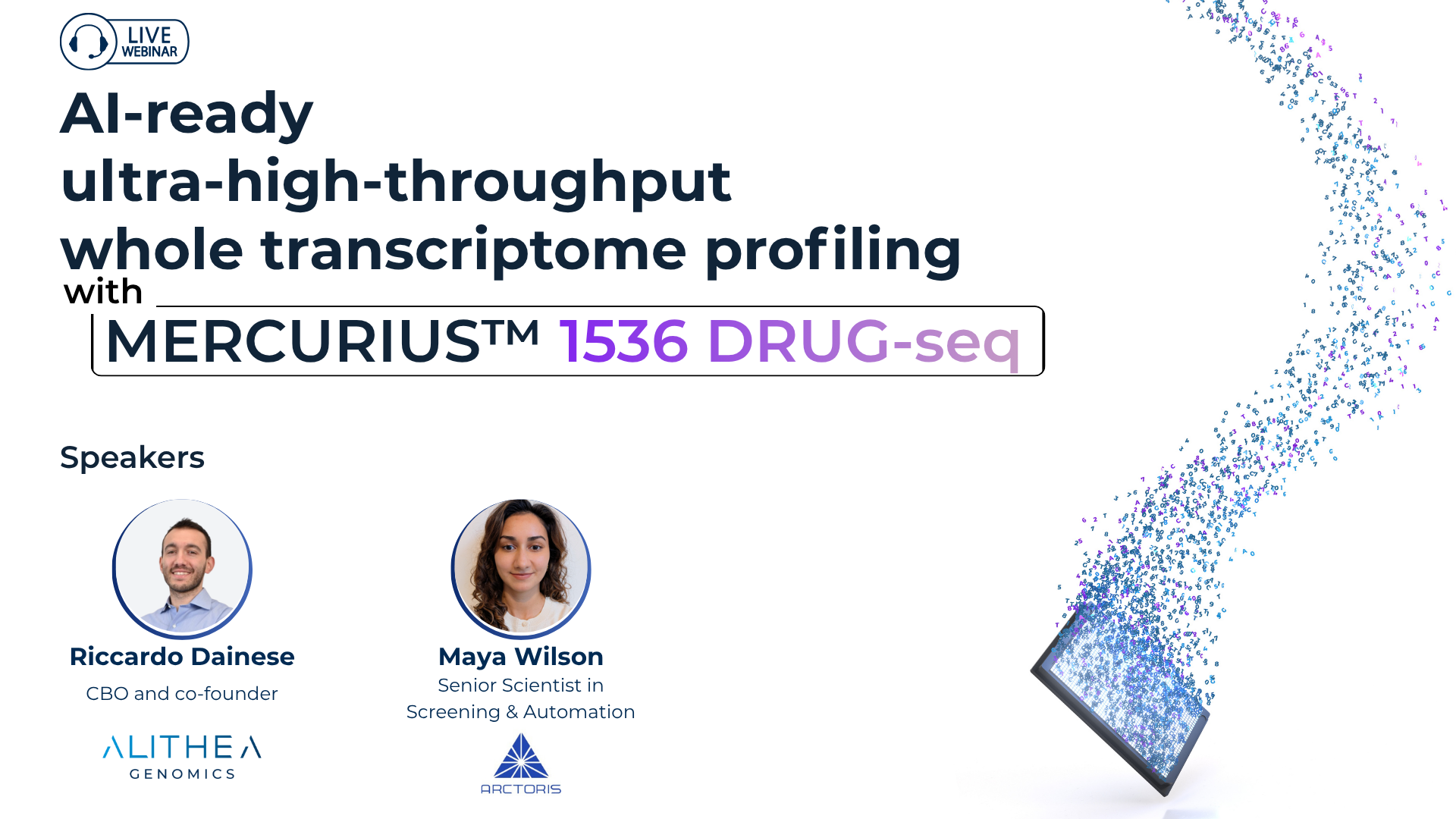
In this early access launch webinar, Alithea Genomics introduces MERCURIUS™ 1536 DRUG-seq, a whole transcriptome profiling workflow designed for applications where 384-well transcriptomic screening becomes difficult to scale or where sample material is limited, e.g., with non-proliferating primary cells or iPSCs. By bringing broad transcriptomic readouts into the density and throughput of modern screening, 1536 DRUG-seq enables discovery teams to generate reusable compound-response datasets for primary screening, mechanism-of-action discovery, toxicity detection, compound prioritization, and AI/ML model development.
Arctoris adds the perspective of how fully automated experimental execution with its proprietary platform, UlyssesⓇ, enables high-density transcriptomic screening to move from technical feasibility to practical drug discovery application. Leveraging fully automated workflows for cell preparation, cell seeding, compound treatment, incubation, and sample preparation in 1536-well format, Arctoris enables reproducible profiling across multiple human cell lines, input conditions and replicates.
Watch to learn how 1536 DRUG-seq expands the practical scale of whole transcriptome profiling, reduces plate count and batch burden, and supports the creation of standardized perturbation datasets that increase in value across screening campaigns.
Key topics you will learn
- Bring whole transcriptome profiling into 1536-well screening workflows
- Build large-scale perturbation datasets across compounds, doses, cell models, and conditions
- Reduce plate count, cost per profile, and batch burden compared with lower-density formats
- Link compounds to biological response at a scale suited to modern screening and AI/ML workflows
- Understand how automated cell preparation, compound treatment, and sample preparation with UlyssesⓇ support reproducible 1536-well transcriptomic screening
- Learn why standardized experimental execution is critical for generating AI-ready perturbation datasets
- See real case studies and data generated with MERCURIUS™ 1536 DRUG-seq