Transforming DRUG-seq sequencing data into reliable biological insights requires a robust and scalable analysis workflow.
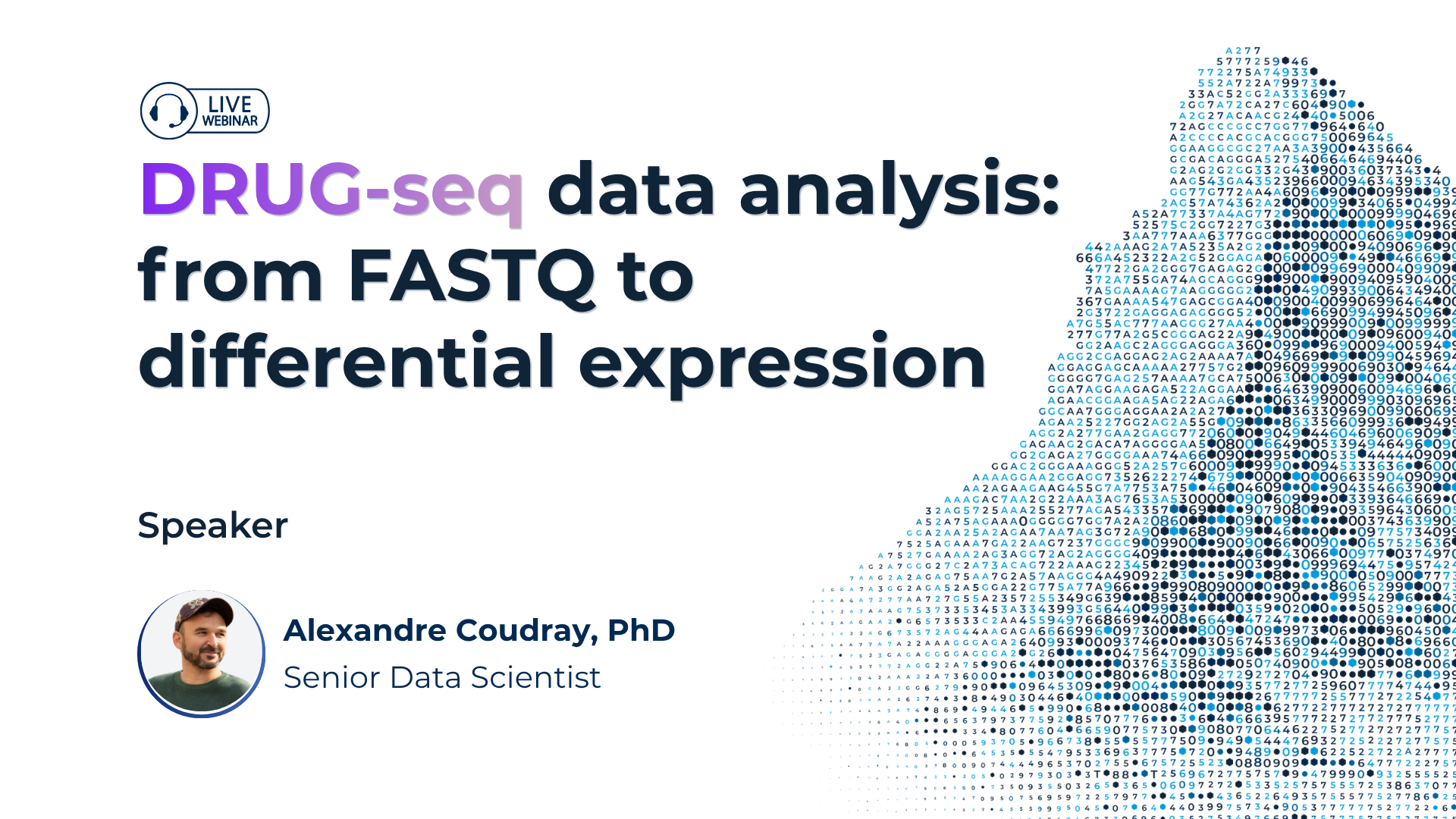
In this webinar, Alexandre Coudray, Senior Data Scientist at Alithea Genomics, walks through the DRUG-seq data analysis journey—from raw FASTQ files to quality-controlled count matrices, differential expression results, and pathway-level insights.
The session covers the essential quality-control steps used to evaluate sequencing performance, samples, plates, spatial effects, technical replicates, and experimental reproducibility. It also explores approaches for identifying bioactive conditions, determining points of departure, and interpreting transcriptional responses through pathway scoring.
Whether you are planning a DRUG-seq experiment or already working with high-throughput transcriptomic datasets, this webinar provides a practical overview of the analytical steps needed to generate robust and biologically meaningful results.
What you will learn
- How DRUG-seq sequencing data are processed from FASTQ files to UMI count matrices
- How to perform plate-, sample-, and ERCC-level quality control
- How to identify spatial effects and other potential sources of technical variability
- How viability data can complement transcriptomic measurements
- How differential expression analysis is performed and benchmarked
- How to assess batch effects, technical replicates, and experimental reproducibility
- How to identify bioactive conditions and determine points of departure
- How pathway scoring can help interpret transcriptional responses
Chapters
00:00 Introduction
01:41 DRUG-seq technology overview
03:30 Sample multiplexing
04:50 Experimental design
06:00 From FASTQ files to the UMI count matrix
07:52 Plate-level quality control
10:20 ERCC quality control
13:21 Sample-level quality control
15:32 Detecting spatial effects
16:31 Integrating cell viability data
19:17 Differential expression analysis
20:26 Benchmarking the analysis
21:32 Evaluating batch effects
22:06 Technical replicates
23:27 Assessing reproducibility
25:25 Identifying bioactive conditions
26:10 Determining the point of departure
26:46 Pathway scoring
28:33 Interpreting pathway activity
31:14 Conclusions
34:17 Upcoming webinars
36:35 Q&A
51:16 Closing remarks