Scientific posters

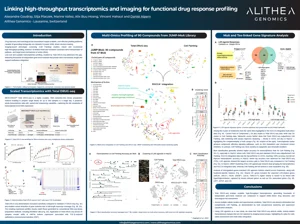
Linking high-throughput transcriptomics and imaging for functional drug response profiling

Drug discovery and toxicological risk assessment require scalable, cost-effective profiling platforms capable of generating biologically rich datasets to power AI/ML-driven decision-making.

Imaging-based phenotypic screening (Cell Painting) enables robust and economical high-throughput profiling, however, its limited molecular resolution constrains direct interpretation of pathway- and target-level mechanisms of action (MoA).

Low-cost and scalable transcriptomics profiling, enabled by Total DRUG-seq addresses this gap, delivering thousands of independent gene-level readouts that provide direct mechanistic insight and support multiomics integration.


Logo Alithea

Screenshot 2026-03-03 at 16.49.40
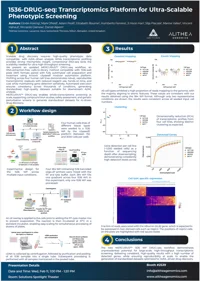
1536-DRUG-seq: Transcriptomics Platform for Ultra-Scalable Phenotypic Screening

We present an updated MERCURIUS™ DRUG-seq workflow, an RNA-extraction-free, cells-to-library method compatible with 1536-well formats and automated liquid handling. Profiling across four human cell lines demonstrates robust, reproducible transcriptomic readouts with reduced reagent use, hands-on time, and cost while maintaining gene detection sensitivity.

MERCURIUS™ DRUG-seq enables whole-transcriptome screening at scale, supporting compound MoA studies, safety assessment, and genetic perturbation screens to generate standardized datasets for AI-driven drug discovery.

Arctoris Dark Blue Logo

Screenshot 2026-03-05 at 12.09.04
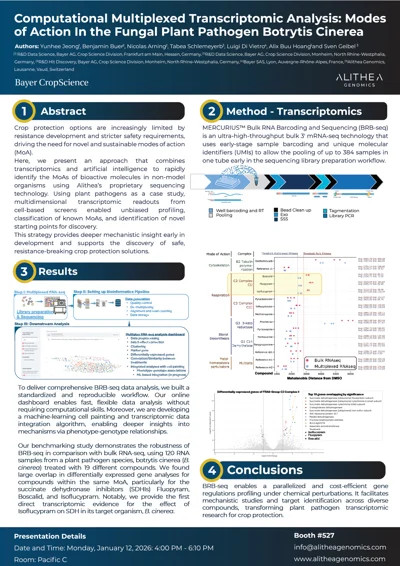
Computational Multiplexed Transcriptomic Analysis: Modes of Action In The Fungal Plant Pathogen Botrytis Cinerea

Here, we present an approach that combines transcriptomic and artificial intelligence to rapidly identify the MoAs of bioactive molecules in non-model organisms. Using plant pathogens as a case study, multidimensional transcriptomic readouts from cell-based screens enabled unbiased profiling, classification of known MoAs, and identification of novel starting points for discovery. 

bayer-cropscience

Screenshot 2026-01-20 at 11.12.23
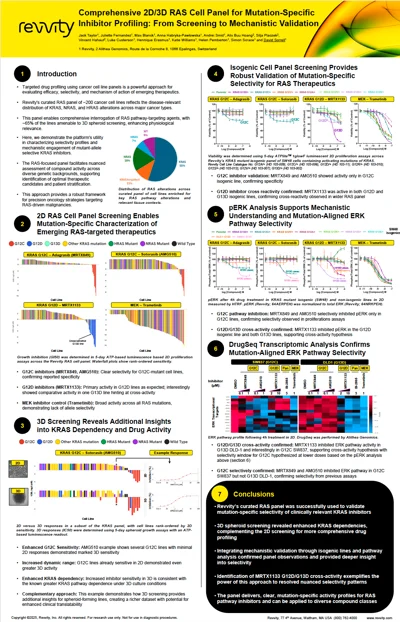
Comprehensive 2D/3D RAS Cell Panel for Mutation-Specific Inhibitor Profiling: From Screening to Mechanistic Validation

Targeting drug profiling using cancer cell line panels is a powerful approach for evaluating efficacy, selectivity, and mechanism of action of emerging therapeutics.

Revvity_Logo

Screenshot 2025-11-10 at 15.47.39
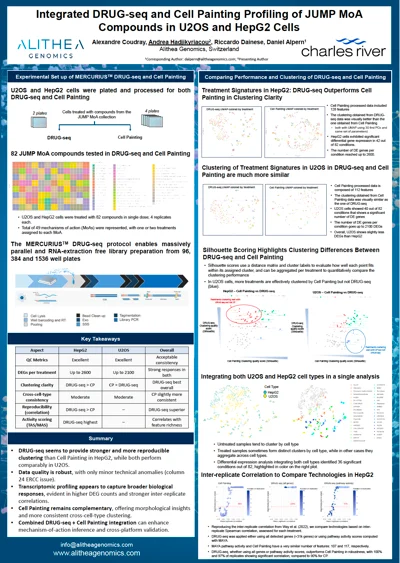
Integrated DRUG-seq and Cell Painting Profiling of JUMP MoA Compounds in U2OS and HepG2 Cells 

DRUG-seq captures broader biological responses, whereas Cell Painting provides complementary morphological insights and consistent cross-cell-type clustering. Integrating both assays enhances mechanism-of-action inference and cross-platform validation.

Charles_River_Laboratories_Logo

Screenshot 2025-11-10 at 18.49.38
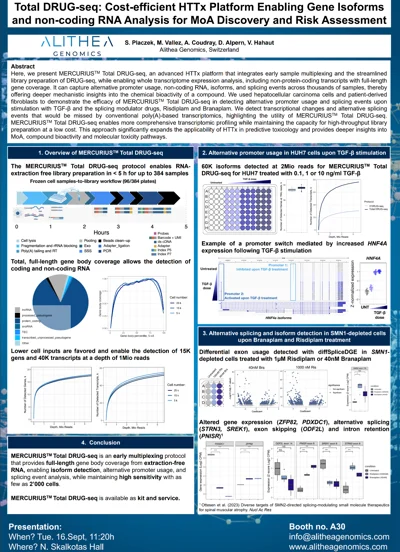
Total DRUG-seq: Cost-efficient HTTx Platform Enabling Gene Isoforms and non-coding RNA Analysis for MoA Discovery and Risk Assessment

MERCURIUSTM Total DRUG-seq is an early multiplexing protocol that provides full-length gene body coverage from extraction-free RNA, enabling isoform detection, alternative promoter usage, and splicing event analysis, while maintaining high sensitivity with as few as 2’000 cells. 

Logo-full-primary

Screenshot 2025-11-10 at 17.25.16
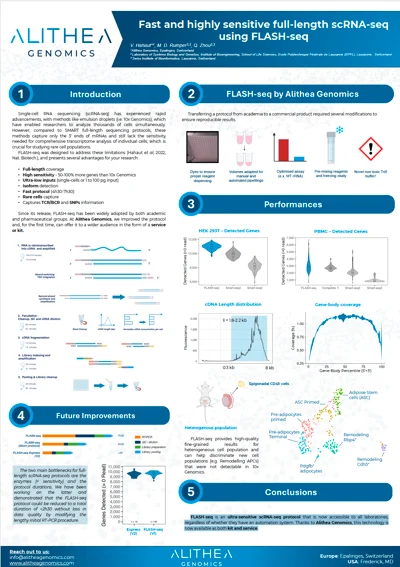
Fast and highly sensitive full-length scRNA-seq using FLASH-seq

MERCURIUS™ FLASH-seq provides full-length mRNA transcript coverage even for low-abundance genes, empowering researchers to explore differential gene expression, detect alternative splicing, and analyze isoform diversity—all critical for understanding complex biology, especially in rare cell populations. This technology is now accessible to all laboratories, regardless of whether they have an automation system. 

Logo-full-primary

Screenshot 2025-11-11 at 09.29.49
Computational Multiplexed Transcriptomic Analysis: Modes of Action In The Fungal Plant Pathogen Botrytis Cinerea

Here, we present an approach that combines transcriptomic and artificial intelligence to rapidly identify the MoAs of bioactive molecules in non-model organisms. Using plant pathogens as a case study, multidimensional transcriptomic readouts from cell-based screens enabled unbiased profiling, classification of known MoAs, and identification of novel starting points for discovery. 

bayer-cropscience

Screenshot 2026-01-20 at 11.12.23
Comprehensive 2D/3D RAS Cell Panel for Mutation-Specific Inhibitor Profiling: From Screening to Mechanistic Validation

Targeting drug profiling using cancer cell line panels is a powerful approach for evaluating efficacy, selectivity, and mechanism of action of emerging therapeutics.

Revvity_Logo

Screenshot 2025-11-10 at 15.47.39
Integrated DRUG-seq and Cell Painting Profiling of JUMP MoA Compounds in U2OS and HepG2 Cells 

DRUG-seq captures broader biological responses, whereas Cell Painting provides complementary morphological insights and consistent cross-cell-type clustering. Integrating both assays enhances mechanism-of-action inference and cross-platform validation.

Charles_River_Laboratories_Logo

Screenshot 2025-11-10 at 18.49.38
Total DRUG-seq: Cost-efficient HTTx Platform Enabling Gene Isoforms and non-coding RNA Analysis for MoA Discovery and Risk Assessment

MERCURIUSTM Total DRUG-seq is an early multiplexing protocol that provides full-length gene body coverage from extraction-free RNA, enabling isoform detection, alternative promoter usage, and splicing event analysis, while maintaining high sensitivity with as few as 2’000 cells. 

Logo-full-primary

Screenshot 2025-11-10 at 17.25.16
Fast and highly sensitive full-length scRNA-seq using FLASH-seq

MERCURIUS™ FLASH-seq provides full-length mRNA transcript coverage even for low-abundance genes, empowering researchers to explore differential gene expression, detect alternative splicing, and analyze isoform diversity—all critical for understanding complex biology, especially in rare cell populations. This technology is now accessible to all laboratories, regardless of whether they have an automation system. 

Logo-full-primary

Screenshot 2025-11-11 at 09.29.49
Computational Multiplexed Transcriptomic Analysis: Modes of Action In The Fungal Plant Pathogen Botrytis Cinerea

Here, we present an approach that combines transcriptomic and artificial intelligence to rapidly identify the MoAs of bioactive molecules in non-model organisms. Using plant pathogens as a case study, multidimensional transcriptomic readouts from cell-based screens enabled unbiased profiling, classification of known MoAs, and identification of novel starting points for discovery. 

bayer-cropscience

Screenshot 2026-01-20 at 11.12.23
Comprehensive 2D/3D RAS Cell Panel for Mutation-Specific Inhibitor Profiling: From Screening to Mechanistic Validation

Targeting drug profiling using cancer cell line panels is a powerful approach for evaluating efficacy, selectivity, and mechanism of action of emerging therapeutics.

Revvity_Logo

Screenshot 2025-11-10 at 15.47.39
Integrated DRUG-seq and Cell Painting Profiling of JUMP MoA Compounds in U2OS and HepG2 Cells 

DRUG-seq captures broader biological responses, whereas Cell Painting provides complementary morphological insights and consistent cross-cell-type clustering. Integrating both assays enhances mechanism-of-action inference and cross-platform validation.

Charles_River_Laboratories_Logo

Screenshot 2025-11-10 at 18.49.38
Total DRUG-seq: Cost-efficient HTTx Platform Enabling Gene Isoforms and non-coding RNA Analysis for MoA Discovery and Risk Assessment

MERCURIUSTM Total DRUG-seq is an early multiplexing protocol that provides full-length gene body coverage from extraction-free RNA, enabling isoform detection, alternative promoter usage, and splicing event analysis, while maintaining high sensitivity with as few as 2’000 cells. 

Logo-full-primary

Screenshot 2025-11-10 at 17.25.16
Fast and highly sensitive full-length scRNA-seq using FLASH-seq

MERCURIUS™ FLASH-seq provides full-length mRNA transcript coverage even for low-abundance genes, empowering researchers to explore differential gene expression, detect alternative splicing, and analyze isoform diversity—all critical for understanding complex biology, especially in rare cell populations. This technology is now accessible to all laboratories, regardless of whether they have an automation system. 

Logo-full-primary

Screenshot 2025-11-11 at 09.29.49
Newsletter

Subscribe to our newsletter

Receive email updates on our latest products and services, news and event updates and more. No ads, no spam.