Our Spheroid DRUG-seq service provides industry and academic scientists with ultra-scalable RNA-seq optimized for 3D cellular models, enabling highly sensitive, RNA-extraction-free, and extremely cost-effective transcriptomic screens for large-scale compound discovery programs, next-generation toxicology strategies, and mechanism-of-action studies.
Discover Sample Datasets
Prostate cancer
Our MERCURIUS™ Spheroid DRUG-seq service is a convenient and scalable solution for projects of any size, enabling transcriptome-wide screening of 3D cellular models.
As part of the Spheroid DRUG-seq service, users simply deliver their 96- or 384-well plates containing frozen cells to us in Switzerland or the United States.
Upon receipt of the plates, our team prepares the libraries, then sequences to your desired read depth per sample, and then performs data pre-processing.
We return results, including raw fastq files, sequencing and alignment reports, and gene count matrices suitable for downstream differential expression analyses, once the data meet our rigorous quality control criteria.
During the process, we always keep clients informed at defined checkpoints so we can decide together how best to proceed to the next steps.
2 days
(Qubit, Fragment analyzer, shallow sequencing)
1 week
1 week
1 week
Raw FASTQ files, sample report file, QC files, and gene count tables
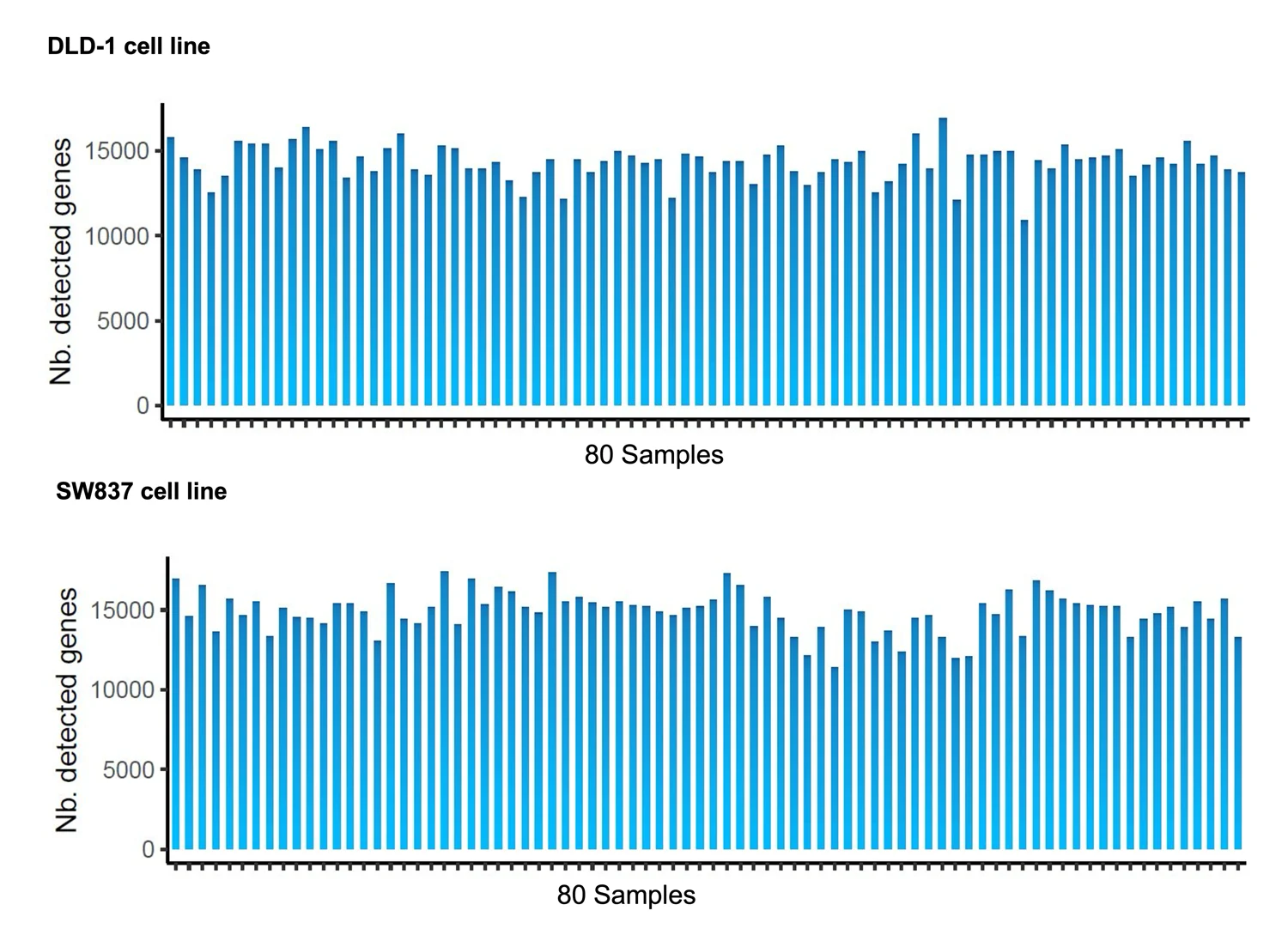
Number of genes detected per sample across 80-sample MERCURIUS™ Spheroid DRUG-seq runs in DLD-1 colorectal cancer spheroids (top) and SW837 colorectal cancer spheroids (bottom). An average of 13,000 genes is detected across all 80 samples from both cell lines at a sequencing depth of 1.7M reads/sample. The uniformity of detection across both cell lines and all samples demonstrates the reproducibility of MERCURIUS™ Spheroid DRUG-seq across different biological contexts.
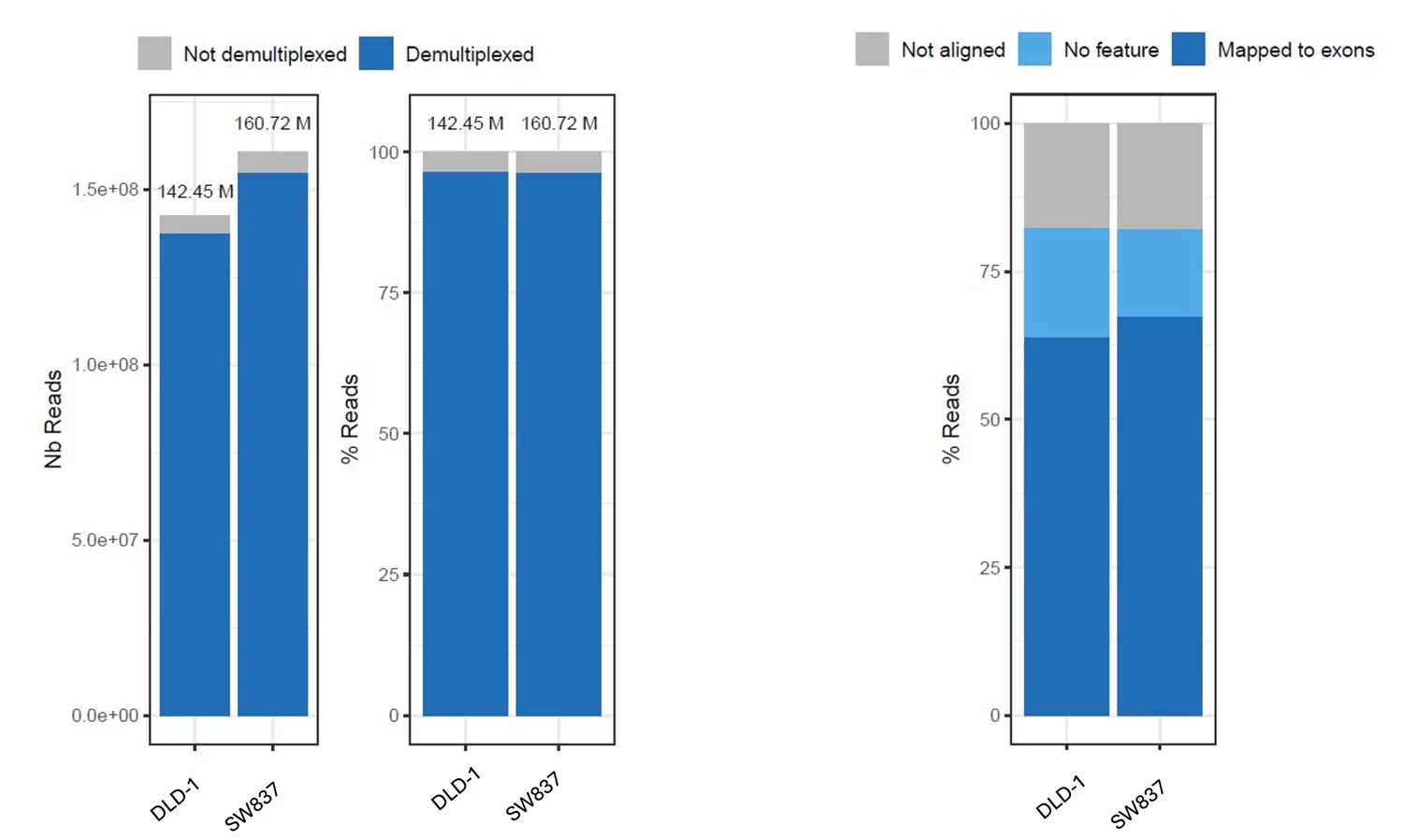
Sequencing quality metrics for MERCURIUS™ Spheroid DRUG-seq libraries prepared from spheroids of DLD-1 and SW837 cell lines. (Left) Demultiplexing efficiency expressed as the number of reads and the percentage of total reads, with both libraries achieving near-complete barcode assignment and minimal read loss. (Right) Mapping breakdown as a percentage of demultiplexed reads. Both libraries show comparable mapping profiles, with 80% of reads aligned, demonstrating consistent library quality across spheroid cell lines.
To have access to the deep-sequenced dataset (24.5 M reads per sample) contact us.
To guarantee high quality data, we normally request that each sample contains 5k-50k cells/well for 96 well-plate or 2k-10k cells/well for 384 well-plate. The minimum number of cells per pool is 80k.
Spheroid DRUG-seq is 3’-end RNA sequencing method and, as such, requires significantly less sequencing as compared to standard full-length RNA-seq in order to reach accurate gene quantification. We therefore normally recommend sequencing between 1 to 10 million reads for each sample, which enables the reliable and unbiased detection of over 18,000 genes.
As part of our standard service pipeline, we align the generated data to the genome of choice, provide a detailed report on the alignment and gene counting statistics and, finally, provide ready-to-use gene count matrices for downstream analysis.
You can either book a call with our experts to discuss your project or submit your experimental details via our contact form so we can review your design and requirements.
Based on the goals, sample types, and scale of your study, we may recommend starting with a pilot project to optimise conditions and de-risk a larger screen.
If you’re interested in implementing the technology in your own lab instead, you can explore our MERCURIUS™ Spheroid DRUG-seq kits on the dedicated kits page.
For the first time, 1536-well whole transcriptome profiling brings biologically rich readouts to primary screening and large-scale perturbation dataset generation. In this webinar, Alithea Genomics…
Biomarker discovery using gene expression signatures has transformed pharmaceutical discovery and development, from early hit triage and target validation to toxicology, dose optimization, and patient…
Next-generation AI models for drug discovery are only as powerful as the quality, size, and perturbation-richness of their training data. Yet no publicly available dataset…